Sunday, March 22, 2015

DVD Review: Diamond Heist

Diamond Heist opens with Terrence Anderson (Michael Madsen) in a gold jacket being a total asshole in some restaurant in London, smashing dishes and whatnot. He makes it a big point of mentioning that he’s lactose intolerant (if you think that will play a significant part later in the film, you are wrong; it’s never mentioned again). He gets a phone call and says, “It’s business as usual around here.” So apparently he’s always an asshole. That, my friends, is the pre-credit sequence.

The film then introduces us to two male strippers who perform in a club full of screaming women until a mysterious chick on a motorcycle shows up and asks them for a light. The guy running the club then calls Terrence Anderson (who owns the club) in a panic, telling him the dancers have disappeared. Why would he bother him with this detail? Why would Terrence care? What, he has only two dancers? I imagine there’s a high turnover in that line of work anyway, so the disappearance of two dancers would hardly be noticed. But no, in the world of this film, male dancers are a rare commodity, and he has to order two new ones from Hungary. Yes, seriously.

So we’re introduced to two somewhat goofy guys driving to work in Hungary. They are late and are soon fired. And with their introduction, the movie gets quite a bit sillier, though the tone remains largely serious. Two other men are hired by Jack Varga (Vinnie Jones) to intercept a package from Terrence Anderson while undercover as his new dancers. Again, why is it so hard to find dancers? And shouldn’t the film have introduced those two men before the two goofy men, so that we’d associate them more quickly as the dancers? As it is, we immediately believe that the goofy guys are the new dancers, so that later when they accidentally become the dancers, it’s no big surprise.

So anyway, the two goofy guys stumble into the intrigue, and decide to pose as the dancers in order to make money. And so they’re to dance at Terrence’s fiftieth birthday party. But then they argue over the plan once they see a tape of the choreography. But who cares? And why is Terrence hiring male strippers for his own birthday party? By this point we’ve already seen Terrence hitting on some female pilot, and there is no indication that he is bisexual, so what gives?

But we have ridiculous scenes of them shaving and trying to learn the dance routine. What does this have to do with a diamond heist, you might be wondering? Absolutely nothing. Not to spoil anything, but in a film titled Diamond Heist, there is no diamond heist. There are diamonds, to be sure, and they most probably were stolen. But there is nothing shown on screen even remotely resembling a heist. (To be fair, apparently the original title was Magic Boys, referring to the two dancers.)

This film desperately wants to be cool, but fails. So then it tries to be funny. After failing at that, it tries to be clever, and fails at that as well. Just putting Michael Madsen in your film doesn’t automatically make it a cool film, though these filmmakers seem to think so. Here is an example of Michael Madsen being tough in this film. While one of his nervous employees is drying his hands in the bathroom, Terrence says: “Do you know how that fucking thing works? It’s basically recirculated air that recently came out of somebody’s ass. So you’re basically drying your hands off with other people’s farts.” What?

Well, the two goofy guys are forced to do a drag act. Why? Who knows? Meanwhile the two real dancers are wandering around the city, acting like they should still be in the film for some reason. But really, the entire film just wanders around for like ninety-four minutes, and by the end you’ve learned to appreciate the time you have and promised yourself you’ll use it better in the future.

Diamond Heist is scheduled to be released on DVD on March 24, 2015. The DVD contains no special features.

Saturday, March 21, 2015

DVD Review: The Shift

The Shift depicts one intense night at an emergency room, where nurse Kayle (Leo Oliva, who also wrote the screenplay) is assigned to train a new nurse named Amanda (Casey Fitzgerald), who holds different views on the responsibilities and obligations of their profession, specifically regarding the question of a patient’s right to die.

This is a film that quickly and quietly gets its hooks into you. Early on there is a shot of a man in a hospital bed, with two people at his side. After a moment, one of them removes the man’s breathing mask. And from there, we see several other patients. These shots are all handled in a quiet, realistic manner, without introductions or exposition, and without intrusions from the score, giving the film an intense and immediate feel. Also, these scenes give us the impression that the focus is as much on the patients as it is on the nursing staff, which is interesting because the two main characters are nurses. But it is that their own focus is on the patients, and so these early brief scenes help align us with those main characters. It is such a great way of making us share their perspectives.

Floyd (Danny Glover) gives the team their assignments for the shift, and Kayle is told he’s to train a new nurse, Amanda. He is reluctant, saying that he should be at the patients’ bedsides where he can do the most good, but of course accepts his assignment. It is a tough night for Kayle, as demons from his past haunt him, and the drugs he uses to get through seem to be giving him anxiety.

There are so many excellent scenes. In one scene early in the night, the nurses work brilliantly and quickly to save a patient, only to learn that the patient’s chart indicates “Do not resuscitate.” So Kayle makes a decision on his own.

Meanwhile a young cancer patient named Emily (Genesis Ochoa) connects with Kayle. This relationship illustrates the dynamic between the needed human touch to medicine and the obligations of the nursing profession. Amanda, eager to learn, asks Emily’s mother several questions about Emily. Kayle pulls her aside and tells her: “Put the notebook away. Listen to me. You need to start treating that girl like a human being and not a homework assignment. Okay? Everything you asked her mom can be found in the chart. All you’re doing is unsettling her with every single question you have.” Emily soon makes an unusual request of Kayle.

Both Leo Oliva and Casey Fitzgerald give very strong performances, and are completely believable. Amanda is intelligent, but doesn’t have the experience to know when to be quiet. Casey Fitzgerald’s performance is so moving. You really feel for her, and because most of us have little or no medical experience, we experience much of this film through her eyes. There is a fantastic moment where she rushes into the med room to retrieve some urgently needed items, and in her frantic mood bangs the door against another nurse, making a third nurse laugh. It’s so brutally honest, and even warm as the third nurse tells her “Just relax” and then helps her get the items. The handheld camera also helps convey her mood and her insecurity. And I love the moments of comradery among the staff.

The Shift is absolutely riveting. I was seriously impressed by this film, and completely drawn in. Not a single moment feels untrue. And though this film is about the right to die, the issue is not addressed in a heavy-handed manner.

The Shift was directed by Lee Cipolla, and was released on DVD on February 24, 2015 through Random Media. The DVD contains no special features.

Friday, March 20, 2015

DVD Review: Code Black

Code Black is a documentary offering an intriguing look at emergency medicine in L.A. County Hospital, focusing on the eye-opening experiences of medical students in that environment. When the film opens, it immediately drops us into the middle of an emergency. We see an extremely crowded emergency room with multiple doctors and nurses working on a patient. It seems insane, and just as we’re thinking that, we get voice over addressing that very thought: “If you’re an outsider, this looks like total chaos. But as a doctor, I see unity in that chaos. There is a team here, in all that, coming together to save someone’s life.”

That’s Ryan McGarry speaking. He was a senior resident physician at the hospital, as well as director of this documentary. He is one of several doctors interviewed for the film, and gives us his initial impressions and reactions to the scene at L.A. County Hospital, as well as a bit of a history of the place. Interestingly, this hospital was the birthplace of emergency medicine, at least in this country. One small area of the room, labeled C Booth, is where more people have died and more people have been saved than anywhere else in the country. (A map on screen shows us it is only twenty by twenty-five feet.)

The film doesn’t shy away from showing us the doctors at work, though it also doesn’t deliberately dwell on anything graphic. As a result, we feel we get a real sense of what the staff goes through, both physically and emotionally, particularly when the footage is not accompanied by any narration. We see patients die, and the way the doctors are affected by it. And there are some personal stories from doctors who became involved in emergency medicine at this hospital, such as Jamie Feng. And director Ryan McGarry relates his personal experience as a patient with stage IV lymphoma when in college, giving the film a personal touch and perspective. The film also shows us the doctors goofing around a bit when they do finally have a break.

Because of earthquake codes, the county had to build a new county hospital, and the feel of it is quite different from the original building. Doctors talk about the differences between the old and new county hospitals, detailing the positive and negative aspects of the change. The film also goes into the current state of medicine and health care in this country.

A “Code Black” is when the number of patients seeking care exceeds the capabilities of the staff. One doctor tells us, “During Code Black we are so saturated that it feels like the place is going to blow up at the seams.” And: “It’s a little like losing before you’ve started.” But despite the title, the focus is really on the L.A. County Hospital and the emergency staff working there rather than on Code Black situations. In fact, it’s more than halfway through the film before Code Black is mentioned. This is a documentary that starts off strong, and then becomes more and more interesting as it goes on.

Special Features

The DVD includes Reconnection, a short promotional film that is part music video, part commentary on the health care system and the removal of the human element in the face of bureaucracy (and the re-introduction of it). There is also an interview with director Ryan McGarry, which begins and ends with footage from the film. Ryan talks about being a film director and doctor, and the similarities between the two professions. He also talks about filming in the hospital, getting access and so on. The DVD also includes the film’s trailer.

Code Black was directed by Ryan McGarry and was released on DVD on February 24, 2015 through Music Box Films. By the way, a pilot for a television series based on this film is being shot now, with Ryan McGarry as one of the executive producers. Marcia Gay Harden, Bonnie Somerville and Luis Guzman are among the cast.

Thursday, March 5, 2015

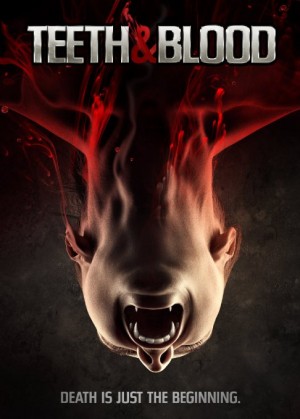
DVD Review: Teeth And Blood

Teeth And Blood is vampire movie that takes place on the set of a vampire movie, where one of the female actors is killed. Two detectives are assigned to go undercover and find out just what happened to this actor. And we learn that the city is missing its blood supply. Hey, also missing are the murder weapon and body. Hmm.

Voice over at the beginning of the film mentions how vampires have adapted and now walk freely among the population, “no longer confined to the shadows.” That’s a nice set-up, promising something different, a variation on the vampire sub-genre. But after introducing this interesting idea, the film then fails to build upon it or use to good effect.

After actor Elizabeth Thornrich is murdered while on the set of a horror film titled Chapel Blood, detectives Sasha Colfax (Michelle Van Der Water) and Mike Hung (Sean Christopher according to the opening credits, and Sean Hutchinson according to the closing credits) are put on the case. They go undercover, immediately getting jobs on the set, Sasha as the new lead actor and Mike as a grip. This is one of the major problems with the film. Sasha is cast on the spot as the new lead (without having a headshot, resume, agent, or even appointment). And Detective Mike Hung is hired as a grip while he seems to be waiting with the people auditioning for acting roles. And it’s the DP that hires him. And this is while the production is in progress. Come on! If there’s one scene that all filmmakers should be able to capture perfectly, it’s that of making a movie. So it does not bode well for this film that they’re completely unable to get even one moment of that right. None of the stuff on the set is the least bit believable. None of the folks on walkies even have headsets. And at one point, Vincent Augustine (Glenn Plummer), the director, tells his assistant that he doesn’t want to be disturbed for at least an hour. An hour? How is his film ever going to get made? Directors don’t leave the set for an hour. The assistant tells him the DP is threatening to walk (maybe that’s because he was put in charge of hiring new grips partway through the production). At another point, dancers show a routine to the director, but while the choreographer is off in a break room. There is no way the choreographer wouldn’t be present for that rehearsal for the director. At another point the director says: “Roll sound. And action.” But we don’t see any cameras or a sound person. And there is no one there to respond, “Sound speed.” Also, it would be the first AD to say, “Roll sound,” not the director. Clearly, the folks that made this movie had never stepped foot on a film set before. Their inexperience shows in every frame.

The stuff about the blood bank crisis is absurd. It seems at times that this movie is intended to be a comedy, except it’s not funny. Anyway, Vincent Augustine is a vampire, and after a while the missing actor turns up as a vampire as well. And soon after that, several crew members are turned to vampires. Just as well, as there was no way they were ever going to finish that movie. And though the crew members are being turned into vampires, there are no real scares, just a series of shots of various people being bitten. The entire film could be a music video set to a single song and you’d lose little if any of the plot. Another problem is we just don’t care what happens to these people.

And it’s never really clear why this vampire makes movies. Is it a passion of his? Or a way to meet potential victims? It would be interesting if he were actually a true film buff and his interest in film defined him more strongly than his vampirism. (But perhaps I’m putting more thought into this than did the writers.) There are hints of an interesting friendship between the film director and another vampire, but this is also left undeveloped. The movie also fails to delve into any weaknesses the vampires might have. They’ve adapted and can walk among us undetected, but have they also developed new weaknesses as a result? We don’t know. It’s another area left unexplored.

Perhaps this was intended to be a comedy. After all, it certainly doesn’t look like a horror film. It uses lots of bright colors. The score doesn’t seem to be going for horror either. It’s more like the music of a procedural police program combined with that of a soft-core porn. It’s difficult to know just what the intended effect is, or what the intended emotion is for its audience.

Beside all that, the writing is so poor. Mike Hung says to Sasha: “So I talked to that maintenance lady. She didn’t know anything though. You find out something?” And Sasha responds, “Not yet.” Great. Thanks for that important and intriguing dialogue. The mayor says, “I don’t need any bad press, especially from reporters.” Wait, who else would give him bad press? Pastry chefs? Bus drivers? Early on, a character says he’s looking for “something very unique.” Whoops! Hey, screenwriters, something is either unique or it isn’t. There are no degrees of uniqueness. And a news reporter named Crystal says, “There was no suicide note to shed why she would have taken her life.” Did she mean “to shed light on why she would have taken her own life”? Bad. Just bad.

Teeth And Blood was directed by Al Franklin, and is scheduled to be released on DVD on March 10, 2015 through RLJ Entertainment. The DVD includes no special features.

Monday, February 16, 2015

DVD Review: Fifi Howls From Happiness

Fifi Howls From Happiness is an unusual and engaging documentary about Iranian artist Bahman Mohassess, who disappeared from the public eye for a long time and re-emerges in this film. The filmmaker, Mitra Farahani, tells us in narration how she tracked him down and found him at the Hotel Sacconi in Rome, where he’d been living for years.

The documentary centers on the resulting filmed interviews with the artist. “And to put your mind at ease, I will tell my life story myself, so that every idiot doesn’t write my biography the way it suits him,” he says early on. And he is immediately likeable. He actually tells the filmmaker how to make the film. “Put this over the image of the sea,” he instructs, and indeed we see an image of the ocean. And in voice over he begins to tell us of his life. It’s such an interesting way of presenting a subject and constructing a film. “I was born on the first of March, 1931, to the south of the Caspian Sea, in the city of Rasht.”

A phone call interrupts his narration, but his side of the call is left in the film. He talks a bit about some of his more recent work, telling the filmmaker which pieces to include in the movie. And we are treated to images of some incredible and original work, some of it in response to political and social situations. He continues to instruct the filmmaker as he lights a cigarette (despite his doctor’s warning): “Make sure you put this in. Make it a wide angle.” And when one day he’s not feeling good enough for conversation, he suggests things for her to shoot instead and tells her then how to use that footage. And yet he never comes across as domineering. He’s endearing, really, with a very particular laugh, which you’ll hear often. (It’s sort of like Ernie’s laugh, from Sesame Street.) But it’s also the little trivial things he says directly to the filmmaker that make him endearing. At one point he gets up, saying: “I won’t give you any coffee. Otherwise I won’t have any for tomorrow morning.”

He talks about destroying much of his own work. And, coughing, he says, “Immortality and all that nonsense.” He has an interesting perspective on today’s attitudes toward homosexuality. “The most devastating thing they’ve done is to eradicate the forbidden character of homosexuality. All its beauty was in the prohibition.” And he talks about his own homosexuality.

Director Mitra Farahani gets Mohassess a commission to do a large oil painting, with the idea that she can then film him at work. Again, this is one more thing making this a rather unusual documentary. She films the meeting between the artist and the two men who commission the work. The director interferes in an odd way, trying to get the men to ask for a bigger piece, trying to get them to ask Mohassess why he depicts fish so often. Why doesn’t she ask him herself? And why leave that in the film?

The film, by the way, is named after one of his paintings, which hangs on the wall behind him during the interview. It’s a painting he’s always kept with him.

Special Features

The DVD includes The Eye That Hears, a 1967 short documentary on Bahman Mohassess, in which he talks about his art and his views on humanity. We do see the “Fifi” painting at the beginning. And the man’s laugh was the same back then. This is approximately eighteen minutes.

The trailer for Fifi Howls From Happiness is also included.

Fifi Howls From Happiness was released on DVD on December 2, 2014 through Music Box Films.

Sunday, February 8, 2015

DVD Review: Penance

Penance is an intriguing drama about a group of woman who in their youth witnessed (or nearly witnessed) the murder of a friend and, being unable to identify the attacker, were tasked by that girl’s mother to either find the killer or do a penance that she approves of. This Japanese mini-series is split into five episodes, each focusing on a different character, and how her life has developed fifteen years after the incident.

The first chapter, “The French Doll,” introduces the characters, opening with the moment that Emili Adachi begins at her new school. The teacher introduces her to the class as the daughter of the new director of a local factory, which immediately sets her apart. And as Emili takes her seat, the film gives us two two-shots of the four classmates whose lives will be forever changed by Emili’s death. Those shots are both perfectly natural and rather creepy. Meanwhile, someone in the area is breaking into homes and stealing French dolls.

While the girls are outside playing, a man, whose face and head are not visible due to interesting and deliberate framing, tells them he’s repairing an air duct and needs the help of one of them. And as we see a wide shot of Emili following the man off, the film’s title comes up. The others continue to joke around, then after a while become nervous. After finding Emili’s body, Maki takes charge, telling each of the others what to do.

Six months later, on Emili’s birthday, Asako (Kyoko Koizuma) gathers the four surviving girls together and berates them for not being able to recall the killer’s face. “Your stupidity is the reason they haven’t caught him after six months,” she tells them. It’s an excellent scene, because you can understand her frustration and anger, and you wonder yourself why the girls can’t offer any help; but on the other hand, they are just children, and they’re being treated by Asako as if they’re older than they are. Plus, the design of the shots is wonderful. The four girls are on one side of the table, while Asako is on the other. Asako appoints them with either finding the killer or paying a penance.

Fifteen years later, Sae works in a beauty salon of sorts. Takahiro Otsuki, a client, wants to meet with her, and Sae’s boss tells her she must. Sae tells Takahio, “I’m defective as a female,” and you feel that the childhood incident stunted or impeded her natural growth as a woman, leaving her forever as a child. But as Takahio explains his own defects, she is won over.

I love the framing of this film. There is a scene where Sae goes to Takahiro’s sparsely furnished home, and is seated at a table deep in the shot. In the foreground is a piece of furniture, a shelving unit with nothing on it, and this works to frame Sae, enclosing her in a box, as if she is the missing French doll of her youth. And Takahiro is so delightfully creepy, in how he treats her, and in the stories he tells her, particularly the excellent one regarding the wasp.

The second chapter, “Emergency PTA Meeting,” returns to the children playing, but this time when the girls split up, we follow Maki, who goes looking for the teacher. Fifteen years later she herself works as a teacher, having become the very person who couldn’t offer help back in her youth. She is now quite strict, even to the point of drawing complaints from parents. A complaint over the confiscation of a girl’s favorite hairpin, a seemingly insignificant episode, reveals Maki’s troubled mind. “I don’t approve of grade school girls dressing up too much,” she says. She points out it was a very ornate hairpin, and adds, “Neither she nor her parents have any idea how dangerous it is to entice men before her time.” And if she was unable to help Emili, she is determined to protect the children now.

Fifteen years after the murder of Emili, Akiko is in a holding cell, telling Asako that she’s paid her penance. Immediately we see that she’s a bit unhinged, simply by the way she moves, the way she carries herself. She tells Asako that she began to live her life like a bear. One thing that’s interesting about this chapter is that it isn’t simply Emili’s murder that has affected and shaped her life, but also Asako’s reaction to hearing the news. Upon finding Emili’s body, it is Akiko that is sent to Emili’s house to tell her mother. In Asako’s rush to get to the school, she pushes Akiko aside, and Akiko falls, resulting in a bloody nose and in her new dress being ruined. And she felt somehow her pride in her new dress was at fault. As an adult, Akiko still lives at home, and becomes close to her brother’s wife’s daughter, becoming protective of her in a way in which she wasn’t of Emili.

The fourth chapter follows Yuka, who immediately strikes us as the most well adjusted. Even as a child, after Asako assigned them penance, she is the only one who seemed able to put it into perspective, telling the others, “I don’t care at all about what Emili’s mother said,” and then: “I don’t believe what grownups say. You should do whatever you want. That’s what I’m doing.” And as an adult she has her own flower shop. But it turns out she’s maybe more of a mess than the others.

In each of the episodes, we learn a bit more about Asako, who is then the focus of the final chapter. And we learn there is a lot more behind this woman than the loss of a child. And yes, there is at least one big coincidence in the story, but it is addressed as such. And the film as a whole is completely engrossing. It is so well shot, so well-constructed, so well-paced. And I got completely caught up in the mystery of it, as well as its characters.

Special Features

The second DVD includes interviews with writer/director Kiyoshi Kurosawa and cast members Kyoko Koizuma, Teruyuki Kagawa, Yu Aoi, Eiko Koike, Sakuro Ando, and Chizuru Ikewaki. Kurosawa talks about writing the screenplay, and about the character of Asako. The cast members talk about their characters. Teruyuki Kagawa also talks a bit about Kurosawa’s directing style. Yu Aoi mentions how her chapter is probably the saddest of the stories. She says, “There is a fine line between perverted desire and pure love.” These interviews total approximately twenty-three minutes. This DVD package also includes a booklet with essays by David Bordwell and Tom Mes.

Penance was written and directed by Kiyoshi Kurosawa, who also wrote and directed the excellent 2001 film Kairo. It’s based on the novel by Kanae Minato. Penance was released on Blu-ray and DVD on November 18, 2014 through Doppelganger Releasing. The film is presented in Japanese with English subtitles.

Wednesday, February 4, 2015

DVD Review: My Straight Son

My Straight Son tells the story of a gay man who is suddenly forced to take care of the straight teenage son he hasn’t seen in several years. While that might sound like the set-up for a comedy, this film is actually a serious and engaging drama. It stars Guillermo Garcia as Diego and Ignacio Montes as his son, Armando.

Diego works as a photographer and is in a steady relationship, but still doesn’t want to completely commit. When Fabrizio (Socrates Serrano), his partner, suggests they move in together, Diego balks. Even though Diego says he’s not into commitment, it is clear that he loves Fabrizio. The film also introduces us to Diego’s friends and family, most of whom play strong parts in Diego’s life, before even mentioning Diego’s son.

Valentina calls Diego to tell him she needs him to take care of Armando while she’s in London getting her degree. There is a bit of clunky exposition when she tells him: “Diego, you are his father. You are no longer the fifteen-year-old brat who got a classmate pregnant.” He tells her he has no time for raising a child, but she lets him know Armando is on his way. The scene where they meet at the airport is done really well. In the foreground there is a bit of awkward distance between Diego and Armando, while in the background between them a father hugs his young son. What I really like is that though they are at first awkward around each other, there is still obviously love there. Diego’s friends are supportive. At one point Fabrizio tells him, “I know this commitment stuff doesn’t suit you, but when it comes to a son, you have no choice.”

The film then takes a more serious turn when Fabrizio is beaten up outside of a gay club and ends up in the hospital, in a coma. This immediately puts everything into perspective for Diego, who acts more tenderly toward his sleeping son, putting a blanket over him. And though Diego might want to reach out to Armando regarding the situation with his partner, he feels he can’t because Armando is upset, feeling Diego doesn’t care about him. Diego himself suffers from self-esteem issues.

My Straight Son boasts some good performances, and is beautifully shot, with a compassionate eye. As always, I could do without the scenes of characters chatting online (those scenes in movies are always dreadfully dull), but the rest of the film is quite engaging. The real title of the film is Azul Y No Tan Rosa, which translates as Blue And Not So Pink. This is a much better and more appropriate title, and whoever decided the English title should be My Straight Son ought to be smacked.

My Straight Son was directed by Miguel Ferrari, and was released on DVD on October 14, 2014 through TLA Releasing and Canteen Outlaws. The DVD contains the film’s trailer. The film is presented in Spanish with English subtitles. (By the way, whoever did the subtitles made a humorous error. According to the subtitles, Diego says, “He’s in the hospital, in a comma.” Ah yes, a most dangerous punctuation mark.)

Blu-ray Review: Falling Down

When Falling Down came out in 1993, I was alarmed by how much I was able to identify with the lead character, William Foster. Part of it, o...