Michael Doherty's Film And DVD Reviews
(And the occasional book review)
Wednesday, June 3, 2026
Blu-ray Review: The House With Laughing Windows
Stefano (Lino Capolicchio) has been hired to restore a painting in a church in a small community. He arrives by boat, which enhances the feeling that the community is cut off from the world he leaves behind. Arriving on that same boat is a beautiful young woman that he exchanges glances with, but no words. Solmi (Bob Tonelli), the man who has hired him, believes that the artist's work will become a main attraction of the town and will bring in tourists to help revive the post-war economy. When we see the painting, we recognize it immediately as depicting a scene similar to what we witnessed in the film's shocking opening. And it isn't long before we hear that the artist was crazy. Then, when Stefano is led to his hotel room, a red-haired woman emerges from another room. The hotel staff member shakes her head, and tells Stefano, "She should stay in her own place doing what she does best." There is a nice moment when the woman, down the hall already, turns back to them. Did she hear what was said, or is she just checking Stefano out? I love how the film introduces us to an assortment of interesting characters all in the first ten minutes. Stefano gets the first in a series of mysterious phone calls, someone telling him to go away. "Don't touch that painting."
There are more unusual characters in the town, and Stefano is surprised by a friend, Antonio (Giulio Pizzirani), who, it turns out, recommended him for the restoration job. He also claims to have discovered an extraordinary story which he needs to share. But even though he is a friend to Stefano, we aren't sure whether we can completely trust him, as there is some word of a breakdown in his recent past, and he seems nervous. Even Stefano worries that he might still be suffering from his illness. The film does an excellent job of aligning us completely with Stefano and making us uneasy about everyone else, without resorting to heavy-handed tactics. The film is also really well-constructed, the way one scene is connected to the next. For example, at one point Stefano sees a woman in the distance collecting flowers. and the film then cuts to some flowers next to him as begins work on restoring the painting. There is even mystery here, as Stefano casually asks Lidio (Pietro Brambilla) who brought the flowers to the church, and Lidio says he doesn't know. Mystery seems to be just under the surface of everything, and Stefano begins to scrape away at it, just as he begins to scrape away at the painting.
After Antonio's questionable death, immediately judged a suicide, Stefano is even more alone. The only other person he had connected to at all was the red-haired woman (who, in another of the film's surprises, turns out to be a school teacher), but when he goes back to her place, he learns she has left town. She has been replaced in her teaching position by the young woman from the boat, Francesca (Francesca Marciano). Because Francesca arrived in this community at the same time he did, Stefano feels he can trust her. And so do we. It isn't long before both of them are in grave danger. The House With Laughing Windows is a fanastic film, full of suspense, and with a wonderfully unsettling atmosphere that never feels unbelievable. In addition, there are beautifully composed shots. There is a reason this film is so beloved and respected. And this Blu-ray edition looks great.
Special Features
The Blu-ray contains a lot of bonus material, including two commentary tracks. The first is done by Alexandra Heller-Nicholas and Josh Nelson, who both immediately say they love the film, and go on to talk about what they appreciate about it (I think, however, that Alexandra does not know what the word "ambivalent" means). The second is by Eugene Ercolani and Troy Howarth, who talk about the Avati brothers and what they're known for in Italy, and how they wrote the initial script several years earlier. Also, interestingly, once they did go into production, the filming apparently went smoothly. That's something you rarely hear about any film. They talk about the priest character, and how there were a lot of Italian genre pictures in the 1970s that featured priests as killers. They say that "a lot of these films could be seen as being vaguely anti-Catholic" or "highly critical of Catholicism," but that's not the case with this film. They also talk about the lack of sex scenes in the film.
There is also, as I mentioned earlier, a feature-length documentary on the film, titled Painted Screams, directed by Federico Caddeo. It contains interviews with director Pupi Avati, producer Antonio Avati, assistant director Cesare Bastelli, costumer designer Luciana Morosetti, assistant camera operator Antonio Scaramuzza, sound man and still photographer Enrico Blasi, and painter Emanuele Taglietti, along with cast memgbers Lino Capolicchio, Francesca Marciano, Giulo Pizzirani, and Pietro Brambilla. Pupi Avati says the film was made by a crew of only twelve people, due to budget constraints, which is crazy. He also says, "When it comes to making so-called 'gothic films,' which would be called 'horror' back in the day, or just scary movies, the key is the protagonist's journey. You must establish a rapport with the protagonist from the get-go." Francesca says, "I think my character's purpose in this story was adding a reassuring presence amidst all this gloom." The documentary gets into the cast and the locations, and even about an earthquake that occurred during production. There is also information about the addition to the film's ending.
The special features also include two featurettes. The first, "La Casa Sola," has Chris Alexander talking about the importance of the opening title sequence, as well as the feel of the film and about this film's place within Italian cinema. The second, "The Art Of Suffering," finds critic Kat Ellinger talking about how the character Stefano represents modernity entering an antiquated community, and talks about the film's relation to artistic traditions. The Blu-ray also contains the film's trailer.
The House With Laughing Windows was released on Blu-ray on December 2, 2025 through Arrow Video.
Thursday, October 3, 2024
Blu-ray Review: Cutting Class
There is an undeniable nostalgia for the music and movies of the 1980s, and certainly for the horror films of that decade. One film, however, that many of us missed the first time around is Cutting Class, which stars Jill Schoelen, Donovan Leitch, Brad Pitt, Roddy McDowall and Martin Mull. The cast alone would make this movie worth giving a second (or first) look. But also it marked the directorial debut of Rospo Pallenberg, known for writing Excalibur and The Emerald Forest. And now that we’re into the month of Halloween, it is the perfect time to enjoy this slasher movie, which received a special edition treatment by the folks behind the MVD Rewind Collection. It includes both an unrated version and the original R-rated release, along with some bonus material.
As the movie begins, a boy is delivering newspapers, and we see the portion of a headline, indicating that a boy who killed someone has been released. Paula Carson (Jill Schoelen) collects the paper, while her father (Martin Mull), dressed as the stereotype of a hunter, is getting ready to leave. He wants the paper, but his daughter keeps it from him, saying, “You’re just going to find something in here that’s going to upset you.” Well, that is a perfect line for our current times, isn’t it? And Paula could not have been more correct, as we soon see the full headline: “Boy Who Killed Father Released From Institution.” Paula’s father says he’s worried about leaving her alone for a week. Paula counters with the fact that she is the one who should worry, saying, “You are a great district attorney, but you’re a lousy hunter.” So while he may have dressed himself in the garb of a hunter, it turns out that isn’t his element at all. That’s a nice bit of characterization there. He gives his daughter the rules for while he’s gone: do your homework, no boys in the house, and no cutting class.
Well, it’s not long before Paula breaks at least one of her father’s rules. But the boy in question is Brad Pitt, so who could blame her for inviting him in? His character is the jock of the film. Donovan Leitch plays Brian Woods, the boy who was released from an institution where he served some time for the death of his father. He tells his old friend Dwight (Brad Pitt), “I’m better now.” Dwight isn’t buying it. But what is more interesting is something else that Brian says, almost under his breath, “I can forgive you.” That is the first moment that makes us wonder which of these two boys we in the audience can trust, if either.
Roddy McDowall is a delight, as always. In this film he plays the principal of the high school (making me think for just a moment about his role as a teacher in Class Of 1984, which came out seven years earlier). Here he is wonderfully creepy, but is not the only adult in the movie who seems to lust after Paula. There is also the art teacher who has Paula model for his class, instructing her to lean over to pick up an apple. Creepy, for sure. And certainly not to be outdone in the creepy factor is the school custodian. So there are plenty of characters for the audience to suspect as the bodies begin to pile up. Not that anyone takes much notice at first. It isn’t until Paul discovers the vice principal’s body draped over the copy machine that anyone realizes something is wrong.
The movie is a bit goofy, no question about it, and there are things that characters do that leave you wondering if they might be a touch stupid, but it’s an overall enjoyable ride. Perhaps my favorite moment is when the principal in a silly wig from the theatre department asks Dwight, “What are you doing?” Roddy McDowall’s delivery is perfect. It’s a funny moment in an otherwise tense sequence. There is also a great scene where Paula and Dwight, on the school’s stage, read aloud from Brian Woods’ trial transcript. That reminds you of the theatricality of court proceedings, as well as the theatricality of this movie itself and its situations. In addition, Jill Schoelen does an excellent job, and it’s her performance that keeps the film grounded in some idea of reality.
Special Features
The Blu-ray disc includes two interviews. The first is with Jill Schoelen, in which she says she initially didn’t want to do the film, that the script had a lot of problems. But she was excited to work with Martin Mull and Roddy McDowall. Their participation is what helped her decide to do it. She also talks a bit about how women were treated in the industry at the time, and how that has changed in more recent years. This interview is approximately twenty minutes. The second interview is with Donovan Leitch, who talks about being a fan of the movies that Rospo Pallenberg wrote, and being excited to be in his directorial debut. He also talks about meeting Brad Pitt on the first day, and about Roddy McDowall. This interview is approximately sixteen minutes.
The bonus material includes a “Find The Killer” contest VHS promotional piece. The sound is not great here, but considering the source, that’s understandable. As I mentioned, both the unrated and R-rated versions of the movie are included on this Blu-ray disc. There is also a piece that compares various sequences of the two versions, showing them side-by-side. The movie’s trailer is also included.
Cutting Class is
available as part of the MVD Rewind Collection.
Friday, February 4, 2022
DVD Review: A Man Called Ove
Early in the film, Ove is let go from his job, not because he’s incompetent, but simply because of his age. But interestingly, he doesn’t put up a fight at all. And soon we learn why. He has decided to kill himself in order to rejoin his wife. In fact, he only stops when he spots someone through his window driving on a path where no cars are allowed. He has to go out to put a stop to that, of course, to restore order. We can’t help but wonder if his current state is due to the loss of his wife, or if he was always of this nature, and soon we begin to suspect the former.
The mixture of comedy and drama works incredibly well here, sometimes within the very same moment or even the same line of dialogue. During his second suicide attempt, the doorbell rings, and he begrudgingly goes to answer it. When he is close to succeeding at killing himself, he revisits his past, and we are treated to moments from his childhood and early adulthood, and we begin to get a sense of what a remarkable person he is, and what a good person he is. In the present, a reporter hints at Ove’s exciting past. And there are other hints of things that have not yet been shown to us, and we find ourselves more and more immersed in this character’s life and world, as he himself becomes immersed in the life of Parveneh (Bahar Pars), his new neighbor.
A Man Called Ove had me in tears at times, laughing out loud for joy at other times. It’s a beautiful and moving film, featuring a tremendous performance by Rolf Lassgård.
Special Features
The DVD contains a few special features. The Ove In Us All: A Talk With Hannes Holm, Rolf Lassgård And Bahar Pars is a look at the main characters through the perspective of the actors playing them, as well as from the film’s director. They talk about the combination of comedy and drama, and about the Saab/Volvo rivalry in that country, something that plays a part in the story. This is approximately fourteen and a half minutes. There is also a Q&A with the film’s directors and stars, moderated by John Anderson. Hannes Holm talks about his reaction to the book. Rolf Lassgård and Bahar Pars talk about how they met, and discuss different scenes. This special feature is approximately twenty-one minutes.
The special features also include a photo gallery showing the makeup for the character of Ove, and a makeup time lapse, showing his makeup being applied and removed. The film’s trailer is also included.
A Man Called Ove was directed by Hannes Holm, and is presented in its original Swedish, with optional English subtitles. It was released on DVD on December 27, 2016 through Music Box Films.
Monday, September 13, 2021
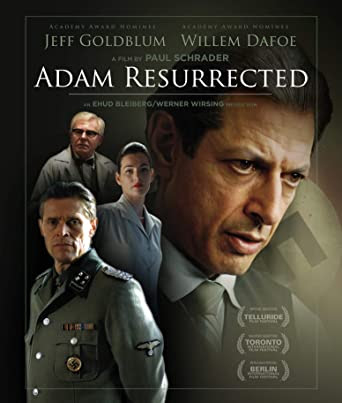
Blu-ray Review: Adam Resurrected
Adam Resurrected
has an unusual and memorable opening. The camera is close on Adam’s face, and
his left eye shifts to either side while his right eye remains stationary. It
is humorously unsettling, and so a perfect image to begin the tale. He speaks
fondly of the past, like a dream, and we see some footage from perhaps a better
time. There is something dreamlike and imaginary about this film, and perhaps
that itself is an answer regarding how people deal with survivor’s guilt. The present
in this film is 1961, and Adam is in Israel. He is playful and familiar with
his landlady, but that hasn’t kept her from calling the authorities on him,
leading us to wonder just how she got the bruise on her neck. He is returned to
an institution in the desert, a place, as Adam tells us in voice over, that is “a home for the survivors of the Nazi camps.”
The shot of the gate in the middle of the desert is rather funny and eerie, a
dreamlike image itself. And we see that Adam was able to get out of his
handcuffs during the drive, just one of the early hints that Adam has some
unusual talents.
Adam may have trouble dealing with life in the present, but he is also having trouble coming to grips with his past. As he looks at a model train, his memory takes him back to another train, where he huddled in a corner with his wife and children. By the way, the trips to the past are shown in black and white (at least up through the war). And we see the life he led up to that point in short bursts, beginning in Berlin in 1926, where he is performing on stage in a small club, a Nazi in the audience laughing and enjoying his performance. As the year changes to 1930, Adam’s career has taken off and he is performing on a larger stage. Adam has a psychic gift, and is able to learn about a person by touching his or her clothing, and on this night he reveals that his “volunteer” in the audience had been planning on taking his own life that very evening. In 1936, Adam is told by the Nazis that he is no longer allowed to perform. “I am not political,” he says to them. “Everyone loves the circus.” His act is a family affair, with both daughter and wife taking part, and we know that all of them are in danger. When in 1944 he arrives at the concentration camp with his family, he meets Commandant Klein (Willem Dafoe), the man who had attended an earlier performance, and who delights in tormenting him, treating him like a dog, taking him as his personal pet. Playing that demeaning role is what keeps Adam alive.
Interestingly, Adam now in turn treats Gina Grey (Ayelet Zurer), a nurse at the institute, in a similar fashion, having trained her to roll over and yelp like a variety of dogs. But Gina is no victim here, for she takes equal part in the game. And she is no fool, knowing at one point that Adam has used her in order to take the keys to a certain room that has aroused his curiosity. That room houses a special patient brought there by Dr. Nathan Gross (Derek Jacobi), a boy who himself was raised like a dog. Adam is at first jealous of the boy, for the boy is crazier than he is, and, Adam believes, is Dr. Gross’ new star patient. But eventually Adam begins to help the boy. That relationship is interesting, but what is far more engaging is the collection of adults who have been brought to the asylum, all survivors of the Holocaust, and the way they deal with or avoid dealing with the horrors of their experience. They all deliver believable performances, but it is Jeff Goldblum’s work here that especially makes this film worth watching. His is a tremendous performance that viewers are unlikely to forget.
Special Features
The Blu-ray contains some bonus material. Adam Resurrected: Behind The Scene features interviews with cast and crew members, including Jeff Goldblum, Willem Dafoe, Derek Jacobi, Hana Laszlo, director Paul Schrader, producer Ehud Bleiberg, writer Yoram Kaniuk, screenwriter Noah Stollman and costume designer Inbal Shuki. Jeff Goldblum mentions that viewers know everything that goes on inside the institute is imaginary, for there was no such place at that time. He also praises the actor who played the boy, and talks about the importance of doing his own best possible work in this role. Yoram Kaniuk talks about his brief appearance in the film. This feature is approximately twenty-four minutes.
There is footage from Q&A at the Haifa International Film Festival. The panel includes Paul Schrader, Yoram Kaniuk and Ehud Bleisberg. Paul Schrader talks about the challenge of adapting a novel for the screen. Yoram Kaniuk is funny as he relates his response to watching the filming. Ehud Bleisberg gives a bit of the history of the attempts at turning the book into a film. They also talk about the film’s setting. This feature is approximately an hour and twelve minutes.
The disc includes an audio commentary track by Paul Schrader, in which he talks a bit about the book and its initial controversy. He also talks about the special look of the flashback scenes, and says the film didn’t get the initial reception he had expected. He also talks about Jeff Goldblum’s performance, and says that Jeff committed the script to memory a year before shooting. The Blu-ray also contains nine and a half minutes of deleted scenes, including an interesting scene with Adam and Commandant Klein, and variations on what leads to Adam going out into the desert. There is an extended scene with Adam and Nathan Gross. The film’s trailer is also included in the bonus material.
This Blu-ray edition of Adam Resurrected was released on June 22, 2021 through MVD Visual as part of its Marquee Collection.
Wednesday, June 30, 2021
Blu-ray Review: The Last Time I Committed Suicide
Most people know Neal Cassady as the real-life inspiration for Dean Moriarty in Jack Kerouac’s On The Road. But I first read about him as the fearless driver of “Furthur,” Ken Kesey’s psychedelic bus, in Tom Wolfe’s The Electric Kool-Aid Acid Test. He is also mentioned in a verse of the Grateful Dead’s “The Other One.” Neal Cassady was greater than fiction, a total force, a completely intriguing character. His brain seemed to operate on a level that was different from that of most people. Jerry Garcia described how Cassady interacted with folks: “You might not see him for months, you know, and he would pick up exactly where he left off the last time he saw you, like in the middle of a sentence.” Before Jerry Garcia met him, before Ken Kesey met him, he wrote a long letter to Jack Kerouac. This was in 1950. Kerouac said he was inspired by that letter, and there had been some efforts by Allen Ginsberg to get it published. The letter was then lost, though Kerouac had apparently copied a third of it or so. Stephen Kay’s film The Last Time I Committed Suicide is based on that letter, or at least on the part that was known at the time the movie was made. For it wasn’t until more recently that the full letter was discovered and subsequently published. It is known as “the Joan Anderson letter.” The Last Time I Committed Suicide stars Thomas Jane as Neal Cassady and Claire Forlani as Joan, and is now being released on Blu-ray as part of the MVD Marquee Collection.
The film opens in black and white, jazz music playing,
the camera hand-held, establishing a lively rhythm. Rhythm was important to
Cassady, in the way he spoke, the way he moved. And in this scene, he is
walking about his home, talking to himself, working out a story, and then
sitting down to type it out in the form of a letter. We see him address it, “Dear Jack.” After the opening titles
sequence, the film goes to color as we move into the story of the letter, and
Cassady visits Joan in the hospital. The film bounces around a bit in time, and
we soon learn that it was a suicide attempt that led to her hospitalization.
The film doesn’t really get into the reason for the attempt, but the letter
makes it pretty clear that Cassady was going to split up with her. In voice
over, Cassady says, “I never asked her
why.”
In the movie, Cassady works at a tire shop with an older man named Jerry (Jim Haynie). In real life, he worked for a railroad company. Cassady tells his co-worker, “Jerry, we come in here, five out of seven, fifty out of fifty-two, make things that are taking people places, and we’re going nowhere.” The movie is about that internal struggle, his desires pulling him in two opposing directions, toward a normal home life with a family, and to a more nomadic existence. We all know how things turned out, but this film takes place in that moment in Cassady’s life before the decision was made, and depicts some events that may have led to it. And it features a pretty great cast. Adrien Brody plays Benjamin, who seems to be based on Allen Ginsberg, and there are some hints of a sexual relationship between them. Keanu Reeves plays Harry, a pool-hall denizen who befriends Cassady and seems to want to lead him into trouble (I’m not sure if he is based on a real person or not). At one point, we see Cassady, Harry and two girls out on the road, freely enjoying themselves. Though my favorite bit with Keanu Reeves in this film is toward the end when he talks about being creepy. “Start with honesty, that’s what my old man said before he took off,” he says. “And I might add that creepiness just so happens to be one of my most powerful traits. Creepiness and neediness.” The film also stars John Doe, Marg Helgenberger, Gretchen Mol and Amy Smart. And watch for an appearance by the boom mic in the scene at the police station.
The film ends as it began, in black and white, as Cassady finishes the letter. Sure, not a lot happens in this movie, as far as a strong narrative goes, but that isn’t really the point. The film depicts a key figure in the beat culture at the time when he was unsure where his life was going, before the events in The Electric Kool-Aid Acid Test, before the events in On The Road, even before he traveled to California. The Last Time I Committed Suicide was written and directed by Stephen Kay, and is scheduled to be released on Blu-ray on July 6, 2021 through MVD Visual. The Blu-ray includes the film’s trailer.
Sunday, May 30, 2021
Blu-ray Review: Switchblade Sisters
Jack Hill has made some pretty wild and fantastic films, standouts being Spider Baby, Coffy and Switchblade Sisters, the last of which has now gotten a special Blu-ray release from Arrow Video. Switchblade Sisters tells the story of a female gang with both external and internal conflicts, brought to the fore when a new girl moves to the neighborhood. First seen as an adversary, and then as a friend, this new girl is not trusted or accepted by at least one of the gang members, and that leads to trouble for all of them. The film stars Robbie Lee, Joanne Nail, Monica Gayle, Asher Brauner, Marlene Clark, Kitty Bruce and Bill Adler. The new Blu-ray release contains a lot of bonus material, including interviews with members of cast and crew, as well a booklet containing photos and essays on the film’s importance.
The movie is compelling from its opening titles sequence, with black and white stills showing a neighborhood in a state of decay, leading to the first scene with Lace (Robbie Lee), a young tough girl, looking in the mirror as she dresses. Here she is in her own world, and in command of it. Then the real world intrudes, and we see the rest of her home, a small apartment, with two young siblings on the couch, and a man there to repossess the television the girls are watching. Lace’s mother explains to the man that she is waiting for a child support check, and needs the money for food, but she does end up paying him. What is interesting is what happens after that, for Lace makes the real world basically bow down to the fantasy world of her own construction. When the man gets on the elevator, she is already there. And at each floor the elevator stops, more tough girls from Lace’s gang get on. And soon they surround and attack the man. What a great way to introduce the gang of girls. You know, it’s funny, the first time I saw this movie, I had no sympathy for the guy at all. Now a couple of decades later, I find I do. After all, he didn’t physically hurt anyone. But a little later we learn the girls didn’t really harm that man either. They just sliced up his clothes and reclaimed the money he’d taken. It is interesting how light and harmless things seem at that point, for the movie does get slowly more serious, as the characters have to deal with some significant troubles. It is also interesting that we see the women on their own at first, seeming to need no one. But then when we meet the male gang members, we find that the women are sort of defined by their relationships to the men, that they haven’t escaped that even in their own world. Even the gang’s name, the Dagger Debs, is in relation to the men’s gang, The Silver Daggers. But you can bet that all changes as the movie goes on.
The gang bullies the wrong girl, Maggie (Joanne Nail), who is more than ready and able to take care of herself. And immediately there is an adversarial relationship between Maggie and Patch (Monica Gayle), a member who lost an eye doing some gang business. But when Maggie ends up in the juvenile detention center with the other girls, they all soon find themselves on the same side, fighting abusive authority figures. By the way, this movie proves once again that the best decade for films was the 1970s, when filmmakers were more daring. When the Debs strike back, things get fun. I particularly love the toilet plunger to the face. But when Lace says she would kill for her man, there is no doubt that she means it. There are a lot of nice little touches in this movie, like when Patch is ready to trip Maggie, and Lace warns her to watch her step. Or later, when the leader of the rival men’s gang asks the slowest typist ever if she’s getting what he’s saying, and then tells her to practice. Again, there is a good deal of humor to this film.
There is also a connection to Shakespeare, as Jack Hill based this film loosely on Othello, with Lace being the Othello character, Patch being Iago, and Maggie being Cassio. Of course, that puts Dominic, the leader of the Silver Daggers, in the position of being Desdemona. And we all know how things turn out for Desdemona. What is interesting to me about Dom (Asher Brauner) is that for all his cruelty, we do see something beneath that hard exterior. For example, when he is reading Lace’s private love letter aloud to the other guys, an act of thoughtlessness and meanness, we can see that he is in fact at least a little touched by it. And we sense as he is reading that he wishes he could just stop and keep the words to himself. Also, later, when he reacts horribly to news that Lace is pregnant, and tosses money at her for an abortion, there is the sense that his reaction comes at least partly from some inner desire to escape his situation, to find a better life, and he is lashing out from fear that a baby will forever tie him to his current state.
Though this is a fun movie, it does touch on some pretty serious subjects, and does so in a way that is honest, and without offering easy solutions, or really any solutions at all. And you do grow to care about these characters.
Special Features
This Blu-ray release has several special features. We’re The Jezebels!: The Making Of Switchblade Sisters contains interviews with Jack Hill, producer John Prizer, casting director Geno Havens, production designer B.B. Neel, stunt coordinator Bob Minor, plus cast members Joanne Nail, Asher Brauner and Chase Newhart. They talk about not having to worry about a studio when shooting, and just focusing all their energy on making a good movie. The casting director mentions that Terri Nunn was one of the girls he brought in to audition. Jack Hill talks about the cast and the influence of Othello on the film. Interestingly, the actors started in theater. This feature is approximately thirty-nine minutes. In Gangland: The Locations Of Switchblade Sisters, Jack Hill returns to some of the locations from the movie. The first place he tries to visit is the junior high school, but it is now completely different. He then goes to the crosswalk where the Debs cross near the beginning of the film. He also visits the restaurant and the roller skating rink. Probably most surprising is that the roller skating rink is still there, and looks the same. This is approximately seven minutes.
The special features also include footage of Jack Hill and Joanne Nail at the New Beverly Cinema for a screening of Switchblade Sisters held on January 3, 2007. And for you movie buffs, as the camera pans to the audience, you can see Clu Gulager (The Killers, The Last Picture Show, The Return Of The Living Dead, Feast) in his regular seat at the front. This is approximately nine and a half minutes. There is also an interview with Jack Hill, Robbie Lee and Joanne Nail, in which they share their thoughts about the film, as well as some memories. They do talk about the Othello connection here, and Joanne Nail is hilarious in that moment.
In addition, there are two trailers for the film, one of which still has the original title, The Jezebels, as well as trailers for several other Jack Hill films. And there are several stills galleries, including behind-the-scenes photos and promotional materials. There is also a new audio commentary by critics Samm Deighan and Kat Ellinger, who talk about the strong female characters in the largely male-dominated exploitation genre. The Blu-ray release includes a booklet featuring essays by Alexandra Heller-Nicholas and Heather Drain, as well as some photos.
This special Blu-ray release of Switchblade Sisters was released on April 27, 2021 through Arrow Video.
Saturday, April 10, 2021
DVD Review: Beats
Beats, set in Scotland in 1994, tells the story of two close friends who decide to attend a rave in protest of a new restrictive and oppressive law, and as a final bit of fun before one of them is to move away. A title card at the beginning gives the historical context for the film: “In 1994, the British Government announced the Criminal Justice & Public Order Bill. It outlawed unlicensed gatherings ‘at which amplified music is played…wholly or predominantly characterised by the emission of a succession of repetitive beats.’” And then the music starts, with a repetitive beat, and we are introduced to the two mates – Spanner and Johnno – dancing in their respective bedrooms while on the phone, excited by the music. The music suddenly stops, and we see the boys’ home lives in a state of relative quiet. The film is mostly in black and white.
Johnno (Cristian Ortega) works at a grocery store, the type of crummy job we all had at that age. Its stifling and lifeless atmosphere is in great contrast to the joy and energy of the music he and Spanner enjoy. His mother’s new husband, Robert (Brian Ferguson), is a police officer, who early in the film attempts to connect to Johnno, but fails. That moment when Johnno goes up to his room and turns on his music is something that we can all remember from our own youths surely, so it’s easier for us to connect to Johnno than it is for Robert to do so. Word comes that there will be an underground rave that Friday, and just in time too, for Robert and Alison (Laura Fraser) are moving the family to a new neighborhood in a week, trying to give them, and perhaps Johnno in particular, a fresh start, away from people like Spanner. But it is Spanner who really needs a fresh start, away from his brute of a brother, Fido (Neil Leiper). And he tries to get it by stealing money from his brother and attending that rave.
When they arrive at the rave, Spanner acknowledges the scene is nothing new, that it’s all been done before. Johnny says yes, but “It’s not been done by us.” And that’s really the thing about being a teenager, isn’t it? It’s nothing new, yet it’s all new to them, and so it matters. That’s a nice moment between them before things get crazy. And when the drugs take hold, the film moves into color. It’s actually a really cool section, with some psychedelic imagery combined with images of machines, working so well with the music. Basically at this point, the film tries to immerse us in the experience the characters are having, and is largely successful. And once having done that, it returns to black and white, and soon trouble arrives, in the form of Fido and his cohorts, as well as the police, who are determined to shut the party down, even if excessive force is needed to do so. The shots of the police moving into the crowd remind me of certain films of the late 1960s and early 1970s, such as The Strawberry Statement. The movie doesn’t end there, however, and what follows is the best and most moving section of the film.
This is a film about friendship, and about taking some chances in the name of friendship. There is a whole lot of joy to this film, and long before the end you will come to care about both Johnno and Spanner. There are also plenty of nice details throughout the movie. In particular, I love the spray-painted message on a wall in the background at one point: “Your fear of looking stupid is holding you back.”
Special Features
The DVD contains few special features. Scotland 1994: The Making Of Beats is a short behind-the-scenes featurette that includes interviews with Keiran Hurley, who co-wrote the screenplay and wrote the play on which it is based, and Brian Welsh, who co-wrote the screenplay and directed the film. They talk about the process of turning the play into the film. Also interviewed are cast members Cristian Ortega and Lorn MacDonald. The shooting of the rave scene is a large part of the focus of this featurette. This is approximately seven minutes.
Two photo galleries are included, the first being production stills, the second being the promotional posters. The film’s trailer is also included.
Beats was directed by Brian Welsh, and released on DVD on September 8, 2020 through Music Box Films. It is presented with optional subtitles. Though the film is in English, interestingly the subtitles come on automatically, as if it were in another language. I suppose that is because people sometimes have trouble with heavy Scottish accents.
Blu-ray Review: The House With Laughing Windows
Right from the film's opening image of a man being tortured, murdered, The House With Laughing Windows is riveting. And as we are still...
-
WKRP In Cincinnati was one of my favorite shows when I was a kid. It was one of those rare shows that my parents loved just as much as I ...
-
The Point is a wonderful animated film that originally aired on ABC in 1971, featuring music written and performed by Harry Nilsson, who ...
-
There is an undeniable nostalgia for the music and movies of the 1980s, and certainly for the horror films of that decade. One film, howev...