Sunday, October 25, 2015

DVD Review: The Saint Seasons 1 & 2

Before he took on his most famous role as James Bond, Roger Moore was Simon Templar in the dramatic series The Saint. For six seasons he played the suave criminal turned detective. Timeless Media Group, a division of Shout! Factory, has now released a ten-disc box set containing all thirty-nine episodes of the first two seasons. These episodes feature appearances by several other actors from the James Bond series, including Honor Blackman, Shirley Eaton, Robert Brown, Joseph Furst and Bill Nagy.

It’s an excellent show, each episode like a mini-film. At the beginning of each episode, Simon Templar directly addresses the camera, taking us into his confidence, sometimes even asking our advice, as in the first episode when he asks, “What should I say?” And then someone will mention Simon’s name and a halo appears over Simon’s head, which leads to the opening credits. In the first episode, a husband seemingly accidentally knocks a heavy pot of flowers from the balcony onto his wife. She survives, but he feels guilty, and begins acting strangely, telling lies and getting to know the pretty new neighbor, who herself begins acting oddly. Soon Simon Templar arrives in town, asking about the husband. There are lots of nice little details, like the bedridden wife hiding her glasses under the covers just before her husband enters, then putting them back on again once he leaves.

The show gives us little hints of Simon’s past and his renown. In the second episode a woman recognizes him, calling him “the famous Simon Templar,” and the Italian police allude to his being arrested before, for example. Some things are dropped, like the character of Hoppy, who works for Simon Templar and is something of a nitwit, trying to steal alcohol from him. This character is introduced in the third episode, and then dropped.

“The Arrow Of God” is a particularly good episode, an interesting whodunit. At the beginning of this one, Simon speaks to us against a gossip columnist (and by extension, against all gossip columnists). At one point, Lucy tells Templar that if the columnist steps out of line, he has permission to kill him. “Me? I’m on holiday,” Simon responds. A good example of the sense of humor of the show. This episode features Honor Blackman as Pauline Stone. “The Effete Angler” features Shirley Eaton as Gloria. Both Blackman and Eaton would of course star in Goldfinger. Another example of the humor comes in “The Man Who Was Lucky,” in which a villain says to Templar, “Haven’t I seen you someplace?” and Templar responds, “Sure, I’ve been someplace.”

“The Golden Journey” is a very different type of episode, in which Simon Templar and an aunt set up a test for a woman who is about to marry one of Templar’s closest friends. Erica Rogers plays the woman. And at the beginning of “The Charitable Countess,” Simon Templar says his own name, rather than someone else saying it, before the halo appears above him. This is a delightful episode. Patricia Donahue is wonderful as the countess, and Warren Mitchell is excellent as Marco, the cab driver who helps Simon. (Warren Mitchell would later turn in an incredible performance as Shylock in the BBC’s 1980 production of The Merchant Of Venice.)

In “Starring The Saint,” a producer is planning on making a film based on Simon Templar’s life, and wants Simon to play himself. As a side note, before this television series, there actually had been a series of films about The Saint. This episode features Jackie Collins as April Quest. And Monica Stevenson is excellent as Peggy. Plus, I love this line from an inspector: “I never believe anything about Simon Templar until I’ve proved it three times, and even then I’m always willing to change my mind.”

“The Saint Plays With Fire” is one of the best episodes. It begins with a neo-Nazi rally, and Templar speaks against it directly to us. It’s an excellent episode about Nazism after the war, with some great characters, particularly Lady Valerie, played by Justine Lord. There is an intense scene involving a lighter. Joseph Furst plays Kane Luker in this episode. He also starred in the final episode of the second season, “The Saint Sees It Through,” this time as Ernst, and would later appear in Diamonds Are Forever.

Another episode worth noting is “Luella.” At the beginning, Simon Templar tells us he’s not a bad person. “It’s just that I am not troubled by my wicked thoughts. In fact, I rather enjoy them.” This episode also plays with the halo bit at the beginning, with Roger Moore giving a quick glance upward as if waiting for it to appear. An old friend, now married, arrives in town and wants Simon to show him the night life. There is some silly slapstick elements in this episode. Wildly, this episode has a James Bond reference at the end. A woman refers to Simon Templar as James Bond. Wow, a bit of first-rate prognostication, that is. And then the episode ends by repeating the halo gag from the beginning.

Special Features

This ten-disc set includes commentary tracks on a few key episodes. On the first episode of the series, “The Talented Husband,” there is a commentary track by Roger Moore, executive producer Robert S. Baker and associate producer Johnny Goodman. They discuss the idea of Simon directly addressing the camera and about the music for the series. The commentary is moderated. Those same three people also provide the commentary on “The Saint Plays With Fire,” one of the series’ best episodes. Robert S. Baker was not only executive producer, but also directed that episode. They talk about the real demonstration against fascism, about Joseph Furst and about the fire scene. Roger Moore also speaks briefly about the film of The Saint, and about Robert Brown, who appears in this episode as well as several James Bond films, including The Spy Who Loved Me, Octopussy and A View To A Kill.

For the “Luella” episode, director Roy Ward Baker and guest star Sue Lloyd provide the commentary track. Both talk about the differences in their names in the credits of episodes (Sue is credited as Susan Lloyd in this episode), and about Roger Moore as a joker on the set. Roy mentions having worked for Alfred Hitchcock.

The Saint Seasons 1 And 2 was released on October 13, 2015 through Timeless Media Group.

Saturday, October 17, 2015

DVD Review: The Horror Network

On the DVD case for The Horror Network, it says, “It’s prime time for evil.” And indeed, October is the prime time for horror movies, as we’re getting prepared for the best holiday of the year, Halloween. And what better way to get yourself in the proper holiday spirit than by watching horror movies? The Horror Network is an anthology of five short horror films, each with a creepy, suspenseful tone. As with all anthologies, some films are stronger than others. Usually, an anthology tries to begin and end with its strongest material, but for me, the three films in the middle are the best of this anthology.

3:00 AM

The first film, 3:00 AM, opens with some nice shots of the countryside while we hear a phone conversation between two women, one of whom has been receiving crank calls. Late that night she hears a thumping and gets up to investigate. The film creates a suspenseful atmosphere, with interesting shots and with sound, and a good chunk of it is without any dialogue. The woman is frightened, but we begin to think it might be in her head. (This one does have the traditional false scare of the cat jumping out.) 3:00 AM was written and directed by Lee Matthews, and stars Charlotte Armstrong.

Edward

On a windy night, two guys are inside talking, and soon it becomes clear that one is a psychologist and the other a patient. The patient has stopped taking his medication and has trouble sleeping. He says he doesn’t want to sleep because of his dreams. “When I wake up, I’m not where I’m supposed to be.” In addition to sleepwalking, he has issues with his mother, and he believes there is something deeply wrong with him. He mentions Alice, a girl from his school who was murdered, a murder he might be responsible for. This one is totally creepy, and gets weirder as it goes, and is able to create a whole lot of suspense with mostly just two guys talking. Edward stars Artem Mishin and Nick Frangione, and was written and directed by Joseph Graham.

The Quiet

The Quiet begins with a child whispering, “I’m going to love you forever and ever, as much as I possibly can,” with a shot of a doll. Dolls are inherently creepy, so right away we’re sort of put on edge. A girl is riding on a bus with other kids. She is nearly deaf, and takes out her hearing aid so as to not hear the other girls, who are teasing her. Soon she is out, walking along a country road by herself, where she keeps seeing the same blue van. And she loses her hearing aid. Like the woman in the first film, she is frightened when there is possibly no reason to be. But childhood is like that. And the film does a great job of showing us the world through her eyes, and through her ears. There is a really nice look to this film, and a good performance by the girl. The Quiet stars Jenni-Lea Finch, and was directed by Lee Matthews.

Merry Little Christmas

Merry Little Christmas is the most graphic of all the films in this anthology, and it too builds a delightfully creepy and unsettling atmosphere. On a Saturday night, Miguel leaves his girlfriend to visit his cousin Cristina and his aunt Lola, and immediately we sense something is wrong in that home. Miguel is worried about Cristina, but the film doesn’t provide us with all the information right away. Then in flashback there is a really horrifying scene of domestic abuse, observed by a young Cristina. And from there, things get more frightening. Merry Little Christmas stars Macarena Gómez, Blanca Rivera and Jan Cornet, and was written and directed by Manuel Marin.

The Deviant One

The Deviant One is the only film of the group to be presented in black and white. It shows a man strangling another man, then taking him to bed. There is no dialogue, but plenty of biblical quotations on title cards throughout. This one is the least effective for me, but the shot in the bathtub is cool. The Deviant One stars Brian Dorton and Brad Anderson, and was directed by Brad Dorton and Douglas Conner.

Special Features

The DVD includes an extended version of The Deviant One, this one with dialogue. But the dialogue certainly does not improve things. Here is part of the conversation at the beginning:
“Do you live around here?”
“I do, yes, actually.”
“You want to come in for a drink?”
“Sure.”
And then when they go inside, the first guy asks, “Water okay?” The version is without the biblical passages. Oddly, the bathtub scene isn’t in it, but a slightly extended version of that scene is included at the end.

The special features also include an image gallery and the trailer.

The Horror Network is scheduled to be released on DVD on October 27, 2015 through Wild Eye Releasing.

Thursday, October 15, 2015

Blu-ray Review: Alleluia

Based on the true story of the Lonely Hearts Killers (the same couple that inspired the 1969 film The Honeymoon Killers, the 1996 film Profundo Carmesi, and the 2006 film Lonely Hearts), Alleluia is an excellent film about love, loneliness, jealousy and obsession. And though we’ve seen this story before, here it is told in such a way that it feels fresh and real and immediate. This films brings us (and keeps us) very close to the two main characters.

Alleluia has a creepy opening. We see a woman, Gloria, giving a sponge bath to a naked man. It takes a moment before we realize the man is dead. And then she looks directly at the camera, directly at us. It’s brief, but long enough to be unsettling. The film is divided into four sections, each about a certain woman, though Gloria is key in all sections, not just the first which bears her name. Gloria is a single mother who is looking at men’s profiles online with a friend, the friend urging her to contact one of them. The camera remains on the women’s faces, never cutting away to the computer screen, which is great. This is a movie that really knows that its characters are what is important, and the camera rarely strays from them.

We are then introduced to Michel, the man that Gloria has contacted, who is practicing what he’ll say in the mirror. He has a photo of Gloria attached to the mirror, which is a bit creepy considering they haven’t yet had their first date. But soon he lights candles for a ritual, saying, “Let Gloria succumb to my charms,” which is much eerier. And on the date, he says just what he’s rehearsed. Gloria takes him home that night, and in the morning when she’s called to work, she leaves her young daughter in his care, a demonstration of her trust, or perhaps her foolishness. But it is for her a demonstration of her love, for she has completely fallen for this man. Even after learning that he’d lied to her, and that he makes his living by seducing women, she wants to stay with him, even to help him. Michel suffers from migraines, and it partly feels as if Gloria is eager to finally care for a living man rather than for the dead. She looks so happy, and he is clearly intrigued. “I’ve never felt so good in my life,” Gloria tells her friend, before basically abandoning her daughter to her.

So then the remaining sections of the film are each named after a woman that Michel seduces, while Gloria poses as his sister. But how long can she possibly be able to watch her man with other women? Her obsession with him borders on madness, to the point of seeing the world outside of the two of them as being dangerous, populated by people who have stopped dreaming, as she says at one point, while standing over the naked corpse of a woman. Gloria is at times like a child, throwing tantrums and so on. She’s also entertained like one, as Michel delights her by making faces for her. But we know she’s much more dangerous than a cranky child.

I love how this film is shot, with lots of close-ups, letting faces do much of the work of conveying the story and the character’s emotions. Plus, because it keeps us so close to Gloria and Michel, we’re never able to get too comfortable. We’re not allowed that distance from which we could more objectively view them, at least not for long. Alleluia is an intelligent, creepy, horror/drama, with excellent performances by Lola Dueñas as Gloria and Laurent Lucas as Michel.

Special Features

This disc contains quite a lot of bonus material, including a commentary track by director Fabrice du Welz. And in case you’re wondering, yes, it’s in English, and at the beginning he apologizes for what he calls his “bad English.” Interestingly, he talks about commentary tracks themselves, saying he feels they’re not necessary. He talks about the real story of the lonely hearts killers, and about two of the earlier films based on that story. He also talks about shooting on film versus video, about the score and the cast. This track was recorded for Music Box Films.

It’s Wonderful When You’re In Love is a short film from director Fabrice du Welz, about a sad, odd, disturbed woman who is alone at home, putting up balloons for her own birthday. She’s hired a man to help her celebrate, but then gets upset when he insists on getting paid. And she may not be the weirdest character in this film. I love the twisted sense of humor in this film. The moment during dinner when she laughs is perfect. This director seems to have a soft spot for lonely, homicidal women.

The disc also contains an episode of Home Cinema hosted by Fabrice du Welz, in which he talks with director Jaco Van Dormael about The Brand New Testament and his earlier work. A section of this episode also deals with Alleluia, with interviews with Lola Dueñas, Fabrice du Welz and Laurent Lucas.

Shooting Alleluia offers a behind-the-scenes look at the film, with interviews with Fabrice du Welz and Laurent Lucas. This is approximately ten and a half minutes. There are also seventeen minutes of deleted scenes, and interviews with cast members Lola Dueñas, Laurent Lucas and Helena Noguerra, as well as with production designer Manu de Meulemeester. The special features also include the film’s trailer.

There is also a booklet with information on the real couple, as well as an interview with Fabrice du Welz and several photos.

Alleluia was directed by Fabrice du Welz, and was released on Blu-ray and DVD on October 6, 2015 through Doppelganger Releasing. The film is presented in its original French, with English subtitles.

Sunday, October 4, 2015

DVD Review: A Plague So Pleasant

Zombies sure are popular these days. That seems due in large part to The Walking Dead, a series that even my girlfriend (who says she hates horror films) enjoys. There are also zombie walks, where people dress up as zombies and… well… walk. And now there are zombie trains as well, where passengers ride through a zombie apocalypse and can even choose to become zombies en route. Why not? And as for zombie films, writers and directors are still finding new and interesting places to take this horror subgenre. Look at A Plague So Pleasant for a prime example of what wonderful new work can be done in the zombie realm.

This film is set a year after the zombie apocalypse, when zombies have become a simple fact of life for those who survived. It has an odd opening, a static shot of a kitchen table, upon which sits a gallon of milk and an empty glass. Soon Todd (Max Moody) enters frame and sits down, facing us. But when he speaks, we hear another man off screen answer. And since Todd looks directly into the camera, we immediately share this unseen man’s perspective. It’s an interesting way to establish that perspective, and align us with Clay (David Chandler). The scene itself is humorous, with Todd asking Clay if his sister Mia is available. And it contains a slightly subtle hint as to what’s taken place, as Clay tells Todd, “Ever since she lost Mom and Dad and Gerry, she’s been so… She needs somebody right now.” And when Clay opens the door to head to work, he sees zombies milling about in the front yard. He walks right past them.

A Plague So Pleasant acknowledges the zombie movies that we’ve all seen, in the voice over narration that Clay delivers during the opening credits. Then he adds: “So when the news reports came in, we were all very well armed. We shot every zombie we saw.” But in an interesting twist, he adds, “When we stopped shooting the zombies, the zombies stopped eating us.” In the world of this film, the zombie apocalypse lasted only twelve hours, and now it’s a felony to shoot a zombie. The film shows us a series of images of zombies in close-ups, as somber music plays, almost like we’re seeing refugees of a war. Plus, all of this is presented in black and white, adding to that feel (while also reminding us a bit of Night Of The Living Dead, and so giving us the sense of beginning the genre over again in a different way). What’s also wonderful about this opening is that it addresses the sort of philosophical and religious questions about death, for in this world no one really dies anymore, but instead everyone wanders forever. And perhaps that’s the most horrible thing of all, worse than death.

The film has an interesting tone, with a quiet and dark humor, implying that both the victims and the survivors of the zombie apocalypse share the same fate, existing in a sort of lifeless world. For example, there is a great scene at Clay’s workplace where he and his co-workers have to sit through a meeting on “Undead Awareness Safety,” with zombies having become as dull a topic as any other that would be brought up at an office meeting. And instead of cemeteries, there are zombie reserves, where you can visit your undead loved ones. As Clay points out, “A tombstone makes it a lot easier to move on.” So when it’s clear to Clay that his sister will never get over Gerry so long as Gerry remains above ground, he returns to the reserve with a gun, intending to kill Gerry so that Mia can get on with her life. And that’s when things suddenly take a drastic turn.

A Plague So Pleasant was written and directed by Benjamin Roberds, and was released on DVD on September 29, 2015 through Wild Eye Releasing. The DVD includes two promotional spots for the film.

Monday, September 28, 2015

DVD Review: The Farewell Party

The Farewell Party is an excellent film dealing with questions of aging, assisted suicide, and the amount of control we have, or should have, over our lives, including how they’ll end. While the subject might sound heavy, the film has a sincere humor at moments, and it is beautifully acted and lovingly shot. Sure, you may be in tears at times, but you’ll also be laughing out loud at other times, as you come to care about this film’s characters.

The movie opens quietly, the camera approaching a man from behind as he makes a phone call. And we see an elderly woman who, with the help of her walker, goes to answer the phone. Then suddenly, a large, echoing voice on the phone calls out the woman’s name, “Zelda.” The woman asks, “God?” And we see both sides of the conversation, as she tells the man she believes to be God that her cancer is back, and the man, who is not God, tells her to be strong, not to give up. He tells her there currently aren’t any vacancies in heaven, and so she should continue her treatments. The man, Yehezkel, a retired inventor, is doing what he can to help her live, while his wife, Levana, lingers behind his chair, clearly supportive.

The film takes place mainly in a retirement home where the residents find they really have to help each other out, that there isn’t much help or understanding coming from outside their small world. The film establishes this by not developing many outside characters, and keeping the perspectives that of the residents of the retirement community. Soon we meet Max, another elderly man being cared for, but clearly suffering. When Yehezkel and Levana go to visit him, Max tells them, “Help me get it over with.” Yana, his wife, wants to help him die, saying, “They’re keeping him alive as though dying is a crime.” While dying might not be a crime, assisting a suicide is, and so they are unsure at first how to proceed, or if they in fact should proceed. Death is obviously on the minds of those who dwell in the retirement community, even on Levana’s mind, as she is intent on passing on one of her recipes to her grown daughter.

Though Levana disapproves, Yehezkel decides to build a suicide machine based on one he sees on the internet, and a small group of friends help Max commit suicide. But then soon another man comes to them, asking for help. The man, Dubek, threatens to turn them in to the authorities if they don’t help him, making him less of a sympathetic character, though of course we understand his desperation.

There are many heart-wrenching moments in this film, like when Levana, who is beginning to suffer from dementia, doesn’t recognize Yehezkel, and keeps repeating that she wants her husband, while he is seated right there beside her. The only weak moment in the movie is the sequence where suddenly many of the characters each sing a portion of a song. This is obviously taken straight out of Magnolia, and it is for that reason that it pulled me out of the story momentarily; also, the sequence wasn’t far enough into the film to have the emotional impact that it did in Magnolia. But other than that, this is an excellent and engaging film.

The Farewell Party was written and directed by Sharon Maymon and Tal Granit, and was released on DVD on September 22, 2015 through First Run Features. The film is presented in its original Hebrew with English subtitles. The DVD contains no special features.

Sunday, September 27, 2015

DVD Review: Meeting ISIL

I’d been deliberately avoiding all news reports of the group called ISIS, in an effort to remain relatively sane. When I hear the word “Isis,” I prefer to think of that excellent Bob Dylan song from the Desire album. But while ignorance may be bliss, my love of documentary films overrode my desire for such bliss, and I popped Meeting ISIL into my DVD player. While the DVD cover has the title as Meeting ISIS, the title on screen is Meeting ISIL. ISIL stands for Islamic State Of Iraq And The Levant, while ISIS stands for Islamic State Of Iraq And Syria, but both are the same group.

Meeting ISIL is a documentary which takes a look at the group, and at the various other factions in the war in Syria. The film opens with a man talking about an operation involving a truck, and then in a wide shot we see the truck explode. The question I immediately had was, Where did this footage come from? That’s a question I had throughout the film, one which is never really answered. A narrator provides just a bit of background information on the area, and then, as we see soldiers letting a car pass, says that soldiers at checkpoints act differently “when strangers with cameras are present.” But why were they allowed to film? And who is doing the filming? Then we see different footage of trucks being stopped at a checkpoint on a Syrian road, and the narrator tells us things look different “when the camera belongs to the Islamic State of Iraq and the Levant.” And indeed, we see the drivers questioned and then executed on the side of the road. But again, there is no mention of where exactly this footage came from. And there is brief footage of an operation at night, but again with no explanation of what it is exactly that we’re seeing.

What is interesting is that operations are recorded and shared on the internet in social media forums (including You Tube and Twitter, and perhaps that is where some footage comes from). Members of ISIL use the internet to get their messages across. The narrator tells us, “Syria has been the most socially mediated civil conflict in history, and the ISIL knows how to use the social media networks to recruit fighters.” It’s also interesting to learn that the al-Nusra Front and ISIL run all the basic services in certain areas, controlling food distribution and even running schools. There is quite a bit of interesting footage, but the film needs to provide more information. I didn’t have enough background information to fully appreciate what I was seeing. The film fails to even define some terms that are used often, such as “Sharia” and “Caliphate.”

The narrator tells us the filmmakers were allowed to film in one of the al-Nusra Front’s training camps in Syria, and one of the men interviewed there is from Morocco (men from many different nations have come there to fight). But the footage of the training camp shows just three guys walking across dirt holding guns. There is no real training, no one there to train them, at least none that we can see, and not even any evidence of a camp. It’s weird. It seems posed. There is also an interview with a man named Abu al-Hefz Sury, who was a member of Islamic State of Iraq and the Levant, but now is fighting with the al-Nusra Front. He holds a gun throughout the interview, and is at some kind of post somewhere. Oddly, the voice of the interviewer is disguised throughout the film. Why? It seems odd that it’s the filmmaker who wishes to remain hidden. The film has no credits whatsoever. So how are we to trust the information? Who made this film?  By the way, this film is less than an hour long, but interestingly there is a two-hour version of it available on You Tube. Perhaps that longer version provides more information? It doesn’t provide any credits (I checked).

Meeting ISIL is scheduled to be released on DVD on September 29, 2015 through MVD Visual. The DVD contains no special features.

Saturday, September 26, 2015

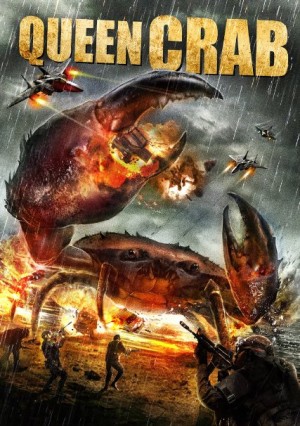
DVD Review: Queen Crab

Queen Crab tells the story of a giant crab that terrorizes the denizens of a small town but has a special relationship with one woman who wishes to protect it. It opens twenty years ago, when a young girl named Melissa finds a crab at the edge of a lake, names it Pee Wee, and feeds it something from her father’s lab. Her father is a scientist who is working on a growth formula to find a solution for world starvation. An explosion in the lab kills both of Melissa’s parents, and her uncle takes care of her, telling her that her pet crab will be okay on its own for a while.

In the present day, Melissa (Michelle Simone Miller) is now a tough chick still living on the same property. And Pee Wee has grown quite a bit in the intervening decades and has begun to raise a family, a family that needs to be fed. A farmer named Phil discovers one of his livestock has been killed and a large hole has been torn into the side of his barn. The sheriff and deputy follow the odd tracks to Melissa’s property. And Jennifer (Kathryn Metz), a childhood friend and now B-movie actor, comes to town to see Melissa. Jennifer asks her what she does, and Melissa responds: “I take care of the property. I protect the things that live here. I keep people away.”

That’s a nice bit of dialogue, and actually quite a bit of the dialogue in this film is good. Sure, some of it is weak, and the acting isn’t always perfect, and there is some less-than-stellar looping. But the film is full of interesting small town characters that are not quite stereotypes (but which play a bit with stereotypes). The scene where the hunting party awaits its prey is particularly good. But the star of the film is the stop-motion animation of the giant crab.

Queen Crab should delight those folks who are old enough to remember monster movies before CG came along and took over and ruined everything. It brings me back to those wonderful, fun movies I’d watch on Saturday afternoons growing up. And for those who are younger, here is a chance to take a break from all the crappy CG movies you’ve likely been drowning yourselves in. There are other elements to remind you of older films, including a few side wipes to transition between scenes. And the opening titles sequence features some humorous appearances by an animated crab. The movie has charm and humor, and even a bit of heart, and it looks pretty damn good. But perhaps what I love most about this film is the relationship between the crab and Melissa.

Special Features

The DVD includes a commentary track by writer/director/producer Brett Piper, producer/actor Mark Polonia, actor Steve Diasparra, and technical assistant Anthony Polonia. They talk about shooting on a low budget (including shooting a scene of four actors with only one microphone), about the locations, and about the effects shots (I appreciate when they speak out against computer graphics). Also included in the special features is Queen Crab Consequences, a behind-the-scenes look at the film (focusing on the crab itself, in a playful way), which features interviews with Mark Polonia, Michelle Simone Miller, AJ Delucia, Rich Lounello, Ken Vansant, Steve Diasparra. Queen Crab Conversations also offers behind-the-scenes information, featuring more from some of the same interviews, with actors talking about their characters and experiences. Composing Crabs is a look at the score for the film, featuring an interview with composer Jon Greathouse. The special features also include the film’s trailer and four minutes of outtakes.

Queen Crab was written and directed by Brett Piper, and is scheduled to be released on DVD on September 29, 2015 through Wild Eye Releasing.

Blu-ray Review: TAG: The Assassination Game

TAG: The Assassination Game is a 1982 film written and directed by Nick Castle (who played Michael Myers in the original Halloween and wou...