Tuesday, June 24, 2014

DVD Review: James Thurber: The Life And Hard Times

James Thurber: The Life And Hard Times is an interesting documentary about the writer who is most well-known for his short story, “The Secret Life Of Walter Mitty,” and also for his work at The New Yorker – both short stories and artwork. The documentary is narrated by George Plimpton, and features several interviews with writers, as well as footage of Thurber.

It opens with a piece from an interview with writer and humorist Stuart Hample, who talks about meeting Thurber at a party. Hample does a sketch of Thurber as he describes him and the scene (a delightful touch). “He stood by the piano and he said, ‘I love music. Christ, how I love music. I always wanted to be a musician. And what am I?’ And he slapped the piano with his hand. ‘What am I? Nothing but a goddamn humorist.’” What a great anecdote to begin the film, with one humorist being described by another, and showing both the humor and frustrations of the film’s subject.

Playwright Edward Albee says of Thurber, “What an extraordinarily good and serious writer he was, when he has the reputation of being a humorist.” He goes on to say, “He’s a very funny writer, but with a tragic sense of humor.” The film also includes interviews with John Updike, Fran Lebowitz, Alistair Cooke, and Roy Blount, Jr. There is also an interview with Rosemary Thurber, his daughter from his first marriage.

The film provides some interesting biographical information. Particularly intriguing is the material on Thurber’s mother and the relationship between her and his father. Thurber’s mother was a prankster of sorts, and biographer Burton Bernstein tells a funny anecdote of one of her pranks. Both parents opposed Thurber’s first marriage, to Althea, and there’s an interesting note that Thurber’s brother Robert boycotted the wedding, but no word on exactly why. (That’s one of the few moments while watching this film when I wanted more information.) Thurber and Althea moved to New York, and in 1927 Thurber sold a short story to The New Yorker. The film then goes into information on that magazine, and the effect E.B. White had on Thurber’s writing, with an interview with senior editor Roger Angell. There is some interesting discussion on the difference between Thurber’s writing and his cartoons, and about the way women are portrayed in the cartoons.

And of course there is a section of this documentary devoted to “The Secret Life Of Walter Mitty,” which was written in 1939 “about a timid man who fantasizes that he is a hero” (Plimpton’s narration). Plimpton says, “It would become Thurber’s most famous work.” What’s interesting about this section is the biographical information, how Thurber’s father was a Mitty-like character, and that Mrs. Mitty is like Thurber’s mother. And there is a little information on the film version, which Thurber disliked, referring to it as “The Public Life Of Danny Kaye.”

The film includes footage from an episode of Omnibus from 1954, where host Alistair Cooke interviews James Thurber. At the age of eight, while playing a William Tell game, Thurber was shot in the left eye with a toy arrow. And late in his life, the vision started to go in his other eye. At the time of the interview, Thurber was nearly blind, and he talks about having to give up drawing completely. But he finds the positive side to be being blind, saying that it allows him to not be distracted from his writing.

By the way, the title of the documentary comes from the title of Thurber’s book My Life And Hard Times. Excerpts of his writing are read to us at a few points throughout the documentary, and the work is quite funny. There is also some wonderful footage of an acceptance speech that Thurber gave late in his life.

James Thurber: The Life And Hard Time was directed by Adam Van Doren and originally aired in 2000. It was released on DVD on June 17, 2014 through First Run Features. Also released on that day was another documentary related to The New Yorker, Top Hat & Tales: Harold Ross And The Making Of The New Yorker, which was likewise directed by Adam Van Doren. There are no special features on the DVD.

Friday, June 20, 2014

DVD Review: In Bloom

In Bloom tells the story of two young men who are in love but find themselves struggling with what they perceive as the ordinary routine of the relationship. It features good performances by the two leads, and a quiet, realistic approach to their story, against a Chicago backdrop and a threat of violence.

The film begins at a low-key party in which Kurt (Kyle Wigent) spots Paul (Tanner Rittenhouse) seated by himself on the couch, and goes to sit next to him. It seems he’s going to try to pick him up. But after a moment he asks, “So how have you been?” And it turns out they know each other. Kurt tells him he now has a normal job and hates it. After an awkward pause, Paul says, “I can’t believe it’s taken you this long to talk to me.” Kurt doesn’t know what to say to Paul. The scene is done almost entirely in singles, which is great, showing the distance from each other that they both feel though they’re next to each other. Paul asks, “What now?” And you feel suddenly that possibilities are opening for them. It’s a really nice scene about regrets and the chance to move forward into the unknown.

Interestingly, after making the viewer think of possible futures for these characters, the film then goes back to seven months earlier. Paul works stocking shelves at a grocery store. Kurt sells pot (so his line about having a job carries more significance), and Paul doesn’t smoke. They’re already together, so it’s not one of those films that go back to the beginning to relate each step in a relationship. Almost immediately we learn, through a television newscast, that there is a series of murders in Boys Town. So that sense of danger hangs over the events of the film, though Kurt doesn’t let it affect him too much.

On the beach they play the game of looking at other people, saying who they’re attracted to. I’m glad the camera remains on them, not showing the men they’re looking at, because it’s not really about those men. Their particulars aren’t important. And by not showing them, the film tells us that Paul and Kurt aren’t taking this game at all seriously, that they’re not going after the men they see. But it also tells us that the idea of Someone Else is in their heads. This film really sticks closely with Paul and Kurt, with lots of close-ups, and because of that, it has an intimate feel.

They have minor arguments, like when Paul tries to get Kurt to eat some of his food at a restaurant, and these work to give the film a realistic feel.  And they each express some longing for change. Paul wants to travel, saying he’s tired of the same old thing (not that he could afford to go to Europe on a stock boy’s wages). And later Kurt talks to a friend about how there might be someone better out there, and that possibility itself is enough to make him destroy a relationship.

Two other men come into play during the course of their relationship. Kevin (Adam Fane) is a man who buys pot from Kurt and hits on him. (That leads to the oddest line of the film, when Kurt says to him on the phone: “How about I head over in about an hour? I’m going to make a sandwich first.” An hour? That must be some sandwich.) Eddie (Jake Andrews) is an awkward young man who works with Paul and who is trying to come to terms with his sexuality. He invites him to his birthday party, telling him he doesn’t have many friends. I really like what Jake Andrews does with Eddie, elevating him from what could easily have been a two-dimensional character.

Of course, we know from the opening scene that their relationship is in trouble, that they will break up. After they do, there’s a nice sequence where they each sit on the edge of a bed, facing toward the camera, and it’s like they’re looking at each other, but they’re in separate apartments. Sadly, it’s followed by a silly montage of them unhappy after the breakup, with Kurt painting his face and going to a club, and Paul drinking by himself. It’s one of the few things in the film that doesn’t quite ring true.

In Bloom was written and directed by C.M. Birkmeier, and was released on DVD on June 3, 2014 through TLA Releasing. The DVD includes the film’s trailer.

Thursday, June 19, 2014

DVD Review: Paul Bowles: The Cage Door Is Always Open

Like probably most of you, I was turned onto Paul Bowles when I read The Sheltering Sky in my late teens. It had a serious effect on me, as it did on others. Indeed, the first lines of narration in the new documentary film, Paul Bowles: The Cage Door Is Always Open, are: “You never know when a book will change your life. In 1997 I read The Sheltering Sky.” The filmmaker goes on to say that he contacted Paul Bowles and set up an interview with him after that, which ended up being one of the last interviews Paul Bowles gave.

The film begins with footage from that interview, with Paul Bowles talking about why he wrote. When asked if he thinks he said what he set out to, Bowles answers, “No, but slowly it came not to matter.” From that moment, I was completely hooked on this film. You could take what he said in a positive or negative light, but the fact that Bowles is in bed in the footage adds to the sort of heartache of what he’s saying.

The filmmaker returns to that interview with Paul Bowles throughout the film, and in some respects it acts as the documentary’s center. At one point Bowles talks about how he thought he’d be a composer. And he did write music, something I wasn’t aware of. Some pieces that he composed for piano are played at various points in the film. For a little while he made a living by composing incidental music for theatre. He also wrote music reviews to earn money.

The film includes interviews with several writers including Gore Vidal, John Hopkins, and Edmund White. There is some weird camera work during the interviews, where the camera approaches a subject from one odd angle or another, and these shots work in conjunction with the more traditionally framed static shots during interviews.

Paul Bowles’ relationship with his wife, Jane, is intriguing, and the documentary gives us several perspectives on it, including those of Gore Vidal and Ruth Fainlight. I did not know that Jane Bowles was also a writer, and I am now excited to read her novel Two Serious Ladies, which was written and published before Paul Bowles wrote The Sheltering Sky. I also found the stuff about Jane being poisoned fascinating, and wanted more information and clarification on that.

Of course, the documentary focuses on The Sheltering Sky, and its popularity. Bowles, in his interview, talks about the reviews and also the money he made from that novel. “I went out and bought a Jaguar convertible,” he says. The film adaptation is also discussed, and the documentary includes an interview with director Bernardo Bertolucci. There is also some information on William S. Burroughs, and a bit about how Paul and Jane are portrayed in the film version of The Naked Lunch.

The documentary gives a little background on Tangier, where Bowles wrote The Sheltering Sky. Another thing I didn’t know about Paul Bowles is that he recorded traditional Moroccan music there, helping to preserve the culture. And the documentary treats us to a couple snippets from those recordings.

Near the end, we return to the main interview with Paul Bowles, and he talks about the importance of laughter. “If you take tragedy too seriously, it swamps you. But if you take it with a shrug and a giggle, you’ll enjoy life more, I think.” Absolutely.

Paul Bowles: The Cage Door Is Always Open was directed by Daniel Young, and was released on DVD on June 17, 2014 through First Run Features. The DVD contains no special features.

Sunday, June 15, 2014

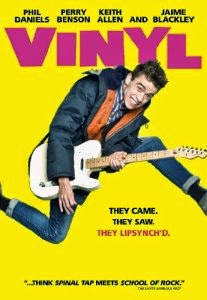
DVD Review: Vinyl

Vinyl is a fun, enjoyable rock and roll film based on Mike Peters’ 2004 hoax, in which he released a single under a fake band’s name. In Vinyl, Phil Daniels plays Johnny Jones, who was lead singer and guitarist for a group called Weapons Of Happiness. Twenty years after the band’s breakup, the members are re-united because of a friend’s funeral. An impromptu late-night jam session at the mansion of one member results in a song which Johnny believes is good enough to be a single, but which the band’s old record label won’t listen to because of the age of the members.

The film opens with Johnny, in an animal print fake fur coat, walking across a field to make a drug purchase from a child. He lives in a trailer with his wife, Jules (Julia Ford), and early on we see him going through old concert posters and other mementos from his time in the band. Clearly things aren’t going all that well for him, and he is still caught up in his more glorious past, but he’s not depressed or anything. He and Jules seem to have a good relationship. When they go to the funeral, Jules is now wearing that animal print coat, and it’s obviously hers. It’s a nice detail, him throwing on something of hers when the need be, and it’s something that comes into play again later in the film.

By the way, the funeral scene features an appearance by Steve Diggle – a very cool cameo by a member of one of my favorite bands, The Buzzcocks. Steve Diggle also provides some music for this film, though most of the music was written by Mike Peters (who is most well known as the lead singer of The Alarm).

Johnny meets the other members of Weapons Of Happiness at the funeral, and there is still some bitterness among them. But they get together for a little jam session at the mansion belonging to Robbie (Perry Benson). When the band’s old recording label refuses to even listen to the resulting track, Johnny has the idea of creating a fake band of attractive young people and putting one over on the label. Johnny says, “And when the single hits the charts, we reveal the scam to the press and shame the corporate tossers for the hypocrites they are.”

I like this cast, and there is something of a music background to several of them. Phil Daniels starred in Quadrophenia. He’s also in one of my favorite rock and roll movies, Still Crazy (which is another film about an aging rock group). And he is a musician himself (he co-wrote "Free Rock 'N' Roll," the main song of this film, with Mike Peters). Keith Allen is also a musician, a member of Fat Les. On film, he portrayed Irving Berlin in De-Lovely, and was also in the television series The Young Person’s Guide To Becoming A Rock Star. Perry Benson appeared in Sid And Nancy. (In addition, several cast members have been in Shakespeare productions. That's not really related to music, but is impressive.)

There are some things that don’t quite work in this film. When Johnny goes to the record company, the secretary is wearing a Buzzcocks T-shirt. But he has apparently not heard of the band, which doesn’t seem believable (though I knew a guy who wore a Cleveland Steamer T-shirt and swore he didn’t know what it meant – right). And the montage of auditions they hold for the fake band is nothing new. There is also a scene where they film a music video for their fake band, and one of the blokes holds a boom microphone. That’s ridiculous for two reasons. First, it’s clearly not plugged into anything; the wire dangles from the end of the pole. Secondly, and this is more important, no sound would be recorded anyway. It’s a music video. And they do smash a guitar at the end of that sequence, something I never like to see. It always pains me.

But those are relatively minor complaints, and there is a lot of really good stuff in this film. I like that when they have their first press conference for the fake band, the girl in the band wears an animal print fake fur jacket similar to the one Johnny’s wife owns. It’s a small detail, but it shows sort of where Johnny's heart lies, and that this project really is his baby. I also like that the “drugs” in this band’s “sex, drugs and rock ‘n’ roll” is Viagra. There’s a brief, but funny and actually charming and sweet scene where Johnny pops the pill. There are some other good music references as well. Jules at one point wears a Clash T-shirt. And of course there is a shot of Johnny walking across Abbey Road.

Another thing that really wins me over is that this film has heart.

Bonus Features

The DVD contains a behind-the-scenes featurette, with interviews with several cast members including Phil Daniels, Chris Turner, Keith Allen, Perry Benson and James Cartwright. Mike Peters is also interviewed, and he talks a bit about the real hoax (though I would have liked more on that). Jules Peters, his wife and the inspiration for the Jules character, is interviewed as well. (She is absolutely beautiful.) And co-writer/director Sara Sugarman is also interviewed. But all of this is quite short.

The DVD also includes the “Free Rock ‘N’ Roll” music video, which is partly the music video from the film, and partly other footage. A photo gallery and the film’s trailer are also included.

Vinyl was directed by Sara Sugarman, and is scheduled to be released on DVD and Blu-ray on July 1, 2014 through Shout! Factory.

Friday, June 13, 2014

DVD Review: Top Hat & Tales: Harold Ross And The Making Of The New Yorker

Top Hat & Tales: Harold Ross And The Making Of The New Yorker sets the stage by opening with footage of New York in the roaring twenties. We learn that Harold Ross, founder and editor of The New Yorker, was a high school drop-out (something I hadn’t known), and then the film immediately goes into thoughts on the magazine by writers such as Philip Hamburger and Stuart Hample.

The film is as much about the influence and style of the magazine as it is about its origins. It includes interviews with many former and current employees of The New Yorker, as well as lots of images of art and cartoons from the magazine.

There is some information near the beginning regarding investor Raoul Fleischmann, and also about some of the magazine’s first writers. Brendan Gill talks about how the magazine was really the product of three men who knew nothing about New York City or the Jazz Age. He says (about Harold Ross, E.B. White and James Thurber): “They were all, in effect, hicks. They were all total outsiders.” John Updike says: “What Thurber and White did bring to The New Yorker was a sense of nervousness. I think they were both truly nervous men.” It was Katharine White who helped provide the sophistication which Harold Ross envisioned for the magazine.

This documentary provides first an overview of the magazine, its style and so on before then providing the viewer with information about Harold Ross himself and his upbringing. We’re halfway through the film before we learn much about Ross, and it is that material that for me is the most interesting. The fact that he began working for his local newspaper in his early teens and then left home for California at age eighteen is interesting. Even more interesting is the story of how after enlisting during the first World War, Ross walked to Paris to work on The Stars And Stripes, and became the editor of that paper. Also intriguing is all of the stuff on how World War II affected the style of the magazine.

Top Hat & Tales: Harold Ross And The Making Of The New Yorker was directed by Adam Van Doren, and is scheduled to be released on DVD on June 17, 2014 through First Run Features. The DVD contains no special features.

Thursday, June 12, 2014

DVD Review: The Soul Man: The Complete First Season

I have to admit that I’d never really given Cedric The Entertainer a chance. And that’s due entirely to his name. His real name is Cedric Antonio Kyles. But he uses the name “Cedric The Entertainer” to distinguish himself from the well-respected Cedric The Drywall Repairman and the widely idolized Cedric The Haberdasher. Anyway, enough of that.

The Soul Man is a situation comedy that stars Cedric The Entertainer as Boyce Ballentine, a singer who returns home to become a minister after his father retires. And he is actually quite good, so maybe I’ve been missing out all these years. The series also stars Niecy Nash as Lolli (Boyce’s wife), John Beasley as Barton (Boyce’s father), Wesley Jonathan as Stamps (Boyce’s younger brother), and Jazz Raycole as Lyric (Boyce’s daughter). The Soul Man: The Complete First Season contains the twelve episodes of the first season, as well as some bonus material.

Boyce Ballentine has moved his family from Las Vegas back to St. Louis because he’s received the calling. In the first episode, “Lost In The Move,” his wife and daughter are still trying to get used to the adjustment. Lolli has the first really funny line of the series: “Honey, we’re all having a difficult time on account of your father.” The episode’s title refers to some items of clothing Boyce is looking for, which Lolli says were lost in the move (meaning she tossed them because she didn’t like them).

There are the usual weaknesses inherent in the sitcom format – some lame jokes, simple plotlines and easy solutions. In “Pastor Interference,” when Boyce and Lolli are about to have sex, he says he wants to get freaky, and actually uses the cliché, “I’ll go get the whipped cream.” That might have been freaky or daring four decades ago, but these days only a fourteen-year-old or a Mormon would consider that kinky. But then Boyce saves it by also grabbing a spatula, and then saying: “Now, God, you’re going to hear your name quite a bit. We’re not asking for help. We’re just saying thank you.” That’s great. There are actually a lot of good lines in this series.

Some of the best material is the stuff delivered quickly. Like during an audition in “The Ballentine Hands,” Boyce says “We’ll call you” and Lester immediately says “We won’t.”  And in “To Leave Or Not To Leave,” when Boyce is on the phone with his mother. He says, “Are you trying to tell me dad was fun once?” She immediately responds: “Twice. That’s how you boys got here.” That episode has a lot of funny material, as when Barton tells Boyce, “We should move this church into the twentieth century.” Boyce corrects him, “Twenty-first.” Barton responds, “Even better.”

It is often Barton who has the best lines. Like in “My Old Flame,” he says, “What she don’t know won’t hurt you.” And in one of the best episodes, “J.C. Carpenter’s Gospel Show,” he’s hilarious when he says “Get out of my way, I gotta go kiss somebody.” His delivery is spot-on. By the way, right near the end of that episode, when J.C. steps up to the front of the church, the congregation applauds. Now, when you work as an extra, they want you to be absolutely quiet, and so you have to fake your applause. But check out the guy in the suit on the left side of the screen. While pretending to clap, his hands don’t come within a foot of each other. It’s like he’s kneading a giant hovering invisible ball of dough. It’s hilarious. I watched it eight times.

This show also has a couple of excellent guest stars. Cynthia Stevenson (whom I love in Home For The Holidays and Happiness) appears in “How To Be A Church Lady” as Carolyn, a woman who is engaged to a man at Boyce’s church and tries to fit in. She is delightful, as always. And in the next episode, “Loving Las Vegas,” Tim Reid guest stars as Henry, the manager of the hotel where Boyce and his family stay. (I will always think of Tim Reid as Venus Flytrap, from WKRP In Cincinnati.) He’s great in this episode.

Be sure to watch the closing credits, because some of the songs that play over them are seriously funny. The closing credits feature different songs for different episodes. The song in the episode titled “The God-Fathers” has lines like “I want you/I need you/I just can’t remember your name.” And the closing song in the episode “Loving Las Vegas” is wonderful. It’s a country song with the line, “How can I miss you if you don’t go away.”

Bonus Features

The two-disc DVD set includes interviews with the cast, totaling approximately fourteen minutes. Cedric The Entertainer talks about appearing on Hot In Cleveland (where the character of Boyce originated), and gives some ideas on parenting. Niecy Nash also talks about parenting. And together they discuss their characters’ relationship. They’re really funny and sweet together, by the way. Wesley Jonathan talks about his character. And the cast talks about the music video and about the joy of taping in front of a live audience.

The Soul Man: The Complete First Season is scheduled to be released on July 8, 2014 through Shout! Factory.

Tuesday, June 10, 2014

Film Review: Breaking Through

Breaking Through is a documentary film about gay men and women in positions in the United States government, told through a series of interviews. The film opens with images from the news media related to the treatment of gay people, and some disturbing images captured in a church, in which the preacher encourages parents of gay children to “Give them a good punch.” But once the film gets going, it’s almost entirely footage from the interviews.

Those interviewed begin by giving brief personal accounts of growing up, relating early experiences in discovering who they were in a world that seemed to hate just that. It’s interesting because all of these people attained positions in government. And that’s really what sets this documentary apart from other documentaries regarding homosexuality. These men and women had the same issues as other gay people while growing up, and they talk about their childhood struggles, their fears, the taunting and abuse they suffered. But just by their current positions within the government, they should be an inspiration to gay youth who might be suffering now. These are folks who are mayors, senators, representatives, Supreme Court justices, secretaries of state and so on.

They then ease into talking about the idea of running for office, many saying they didn’t think it possible. Toni Atkins (California State Assembly Member), for example, says: “I’d never intended to run for office. I didn’t think it was possible. I just didn’t think America was about me.” And Bonnie Dumanis (District Attorney, San Diego) says, “I always thought being gay was going to be a barrier to whatever I chose, and I was certainly in the closet for a long, long time.”

There are a lot of people interviewed, which is both a strength and weakness of this film. It’s a strength in that it shows the large number of gay people who have achieved these positions, which is wonderful. But it’s a weakness, as the film doesn’t delve too far into any one particular story during the first half. During the second half of the film, several of the subjects interviewed receive more focus.

Some talk about how they were forced out of the closet by stories in the press. Barney Frank (U.S. Representative, MA) talks about how he tried to be privately gay and publicly not gay. Karla Drenner (State Representative, GA) tells an incredible anecdote about applying for high-level clearance and being asked if she were homosexual. Her answer is wonderful: “Not at this moment.” There are a lot of positive stories, such as that regarding Alex Wan (City Councilman, Atlanta), who was accepted by his family and who ran as an openly gay candidate, receiving overwhelming support from his community.

The score to this film at times is a distraction. Kate Brown (Secretary Of State, OR) tells an interesting anecdote about her first job, but the serious dramatic music overpowers rather than underscores what she’s saying.

As I indicated, the film is made up almost entirely of interviews. But there is some news footage approximately two thirds of the way through regarding Dick Armey calling Barney Frank “Barney Fag.” We’re treated to Armey’s explanation: “I mispronounced the name of my friend and colleague Barney Frank in a way that sounds like a slur.” And yes, the film gives us Barney Frank’s reaction: “Armey said that, he clearly meant to say it.” Frank makes a great point – that Armey had to answer to it, whereas ten years earlier he likely wouldn’t have had to. “The fact that he felt compelled to lie about it was an indication that we had made progress.”

The film really does ultimately have a positive message for gay youth, who should be inspired by the people interviewed in this film. And, as David Cicilline (U.S. Representative, RI) says: “It matters a lot for openly gay and lesbian candidates to run for office, because just running for office really does help to change people’s hearts and minds. It can help a community have conversations that they otherwise wouldn’t have.”

I would have liked more on their perspectives regarding specific recent anti-gay legislation, and how they handle it. And it would have been good to have a bit more news footage to break up the interviews (I wanted to know just where that opening footage in the church came from, and the film never returns to it). By the way, there are no interviews from those with opposing viewpoints, just a few shots of those morons with the signs about God hating gay people.

Breaking Through was directed by Cindy L. Abel.

Blu-ray Review: Falling Down

When Falling Down came out in 1993, I was alarmed by how much I was able to identify with the lead character, William Foster. Part of it, o...